Escape Road Police & Wanted Levels Guide
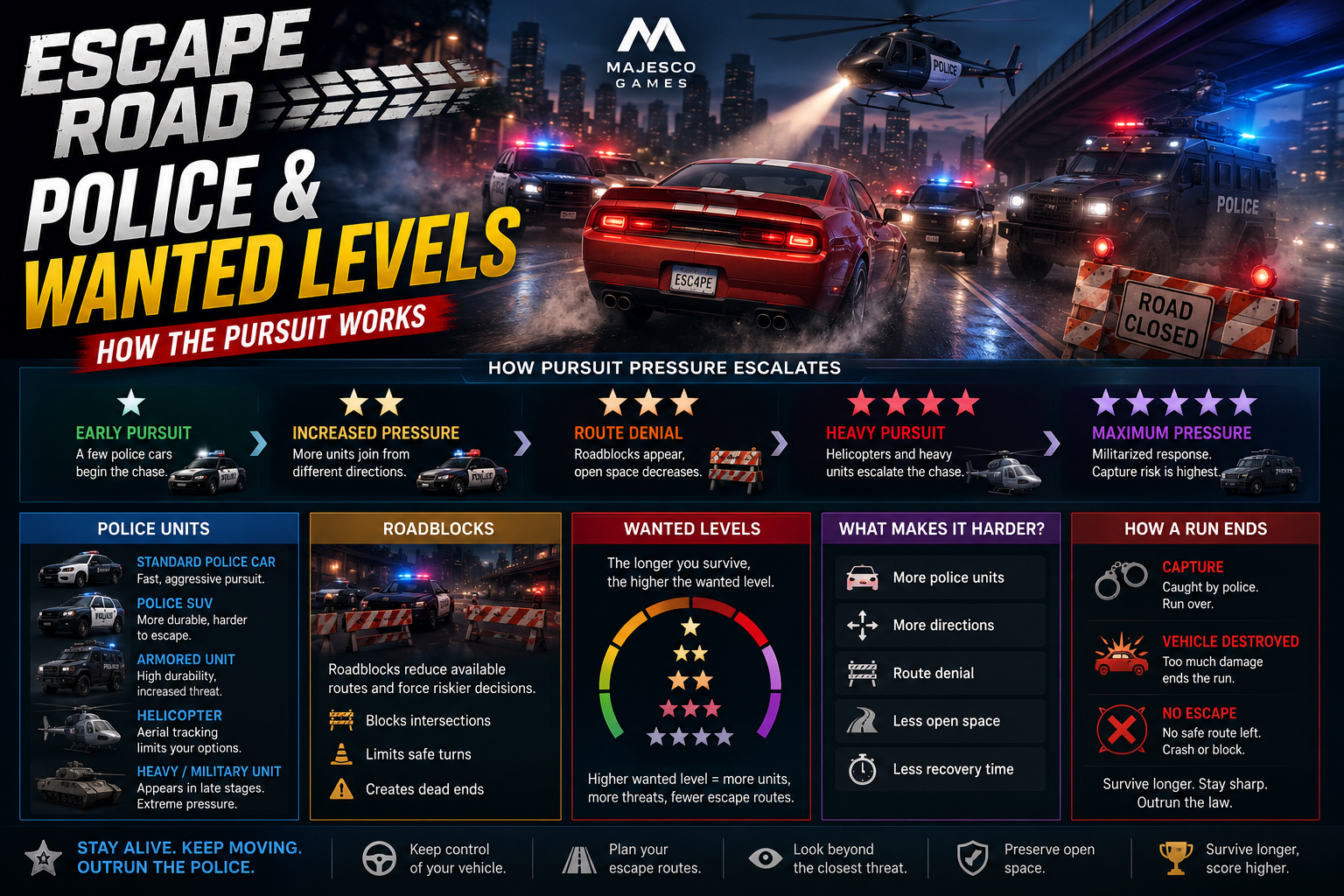
The Escape Road pursuit becomes more difficult as police pressure grows and fewer safe routes remain available.
The police chase is the system that gives Escape Road its constantly increasing pressure. There is no finish line to reach and no final corner that ends the pursuit. The objective is to keep the getaway alive while the game gradually makes the road around you harder to use.
This guide focuses on the police system itself: how the pursuit develops, what wanted pressure means, how different threats affect the road, and why a chase becomes harder over time. If you are looking for controls, route planning, recovery, and player strategy, use our how to play Escape Road guide.
How the Police Pursuit Works in Escape Road
Police pursuit is not simply a group of cars following the player from behind. It is the main difficulty system of Escape Road.
Early in a run, the road usually offers enough room to react to individual threats. As the pursuit develops, more pressure can appear around the vehicle, routes become harder to use cleanly, and mistakes become increasingly difficult to recover from.
The basic escalation can be understood as:
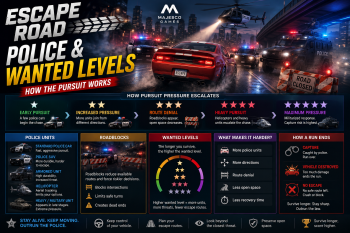
pursuit begins → police pressure grows → more routes become contested → recovery space decreases → capture risk increases.
This is why surviving a long Escape Road run eventually becomes less about outrunning one police car and more about managing the entire space around your vehicle.
What Are Wanted Levels in Escape Road?
The wanted level represents the growing intensity of the pursuit. As a run continues, the game can increase the amount and variety of pressure used against the player.
It is more useful to think of wanted level as an escalation indicator than as a simple timer. A higher level means the chase has moved into a more dangerous state, with less room for careless turns, unnecessary collisions, or slow recovery.
Escape Road is commonly documented with a five-star wanted system, with five stars representing the most intense pursuit state. However, the exact timing of each increase should not be treated as a fixed rule across every browser build unless it can be observed directly in that version of the game.
How Police Pressure Escalates
The pursuit does not become difficult through speed alone. Its real challenge comes from the way several forms of pressure begin working together.
Early Pursuit
At the beginning of a run, the player normally has more open space and more time to understand how the current vehicle responds. Police vehicles provide direct pursuit pressure, but there are still many possible roads and intersections to use.
Growing Pursuit
As the chase continues, the player has to track more than the closest police vehicle. Threats can approach from additional directions, and previously open roads may no longer remain safe by the time you reach them.
Heavy Pursuit
Under heavier pressure, roadblocks, helicopters, larger pursuit vehicles, and other hazards can make the city increasingly difficult to navigate. The important change is not simply that more things are chasing you. The number of useful escape options begins to shrink.
Maximum Pressure
At the highest wanted state, the pursuit can include the game's strongest response. At this point, the challenge is maintaining movement and finding usable space while several different threats compete for the same roads.
Police Cars and Pursuit Units
Escape Road uses different pursuit threats to create pressure in different ways. Not every unit needs to behave identically for the chase to become harder.
Standard Police Vehicles
Regular police cars form the basic moving pursuit. Their main threat comes from closing distance, approaching from different directions, and reducing the amount of space available for a clean turn.
Heavier Pursuit Vehicles
Larger police or military-style vehicles increase the physical presence of the pursuit. Their size can make already crowded roads more difficult to cross and can make a poorly chosen route harder to recover from.
Helicopters
Helicopters are associated with higher-pressure stages of the chase and make the pursuit feel much larger than a normal street-level police response. Their appearance is another sign that a run has moved beyond its early pursuit state.
The exact combination of threats can vary with the game build and progression state, so individual units are best understood as parts of a broader escalation system rather than as a fixed sequence that always appears at an exact second.
How Roadblocks Change the Chase
Roadblocks are especially important because they create a different type of pressure from a police car.
A moving police vehicle follows and closes space around you. A roadblock can remove part of the road before you arrive.
In simple terms:
Police vehicle = moving pursuit pressure.
Roadblock = route-denial pressure.
This matters because Escape Road is largely a game of maintaining options. An intersection with several usable exits gives you room to react. If a roadblock removes one direction while police vehicles approach through others, the same intersection can quickly become a trap.
The important effect of a roadblock is therefore not only collision risk. It changes the route network available to the player.
What Actually Makes the Police Chase Harder?
A common way to describe increasing difficulty is to say that the police simply become stronger or faster. In practice, the pressure is more complicated.
Several factors can make a late chase much harder than an early one:
- More pursuit units: more vehicles can occupy roads around you.
- More approach directions: danger is no longer limited to what is directly behind the car.
- Route denial: roadblocks and crowded intersections can remove otherwise useful exits.
- Less open space: several threats can push the player toward buildings, traffic, water, or confined routes.
- Less recovery time: a collision or poor turn becomes more expensive when the pursuit is already close.
The result is a simple relationship:
more pressure → fewer options → less recovery time → greater capture risk.
Why Open Space Matters More at Higher Wanted Levels
Open space gives a moving vehicle options. It provides room to change direction, recover from a correction, cross an intersection, or avoid a threat arriving from another road.
As wanted pressure increases, that space becomes more valuable because several threats may need to be considered at once.
A fast vehicle with nowhere useful to go is still in danger. A controlled vehicle with several open exits has a much better chance of keeping the run alive.
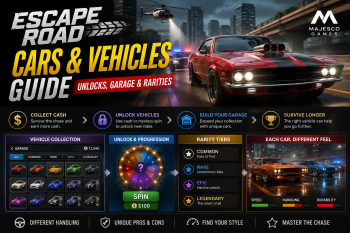
This is also why different Escape Road cars and vehicles can feel different once a pursuit becomes crowded. Vehicle size, turning response, and recovery can affect how comfortably a player uses the space that remains available.
What Happens When the Police Catch You?
A run ends when the player can no longer keep the getaway moving successfully. This can happen after the vehicle becomes trapped, loses control in a dangerous position, takes too much punishment, or otherwise reaches a failure state where the pursuit can no longer be escaped.
This is why one collision does not always matter only because of the impact itself. A crash can remove momentum, change the direction of the vehicle, and give surrounding police enough time to close the remaining space.
Under low pressure, there may still be time to recover. Under a high wanted level, the same mistake can end the run because fewer safe options remain.
Police Pressure and Player Strategy
Understanding the police system changes how you read a chase. The goal is not to react to every police vehicle individually. The more useful question is what the pursuit is doing to the space around you.
If several threats are approaching the same intersection, the important problem is not which police car is closest. It is whether a usable exit will still exist when your vehicle reaches that point.
Detailed driving tactics, route selection, momentum management, and collision recovery are covered separately in our Escape Road gameplay and strategy guide.
Police Systems Across the Escape Road Series
Police pursuit is one of the defining ideas across the Escape Road series, but that does not mean every game uses an identical wanted system, set of pursuit units, or escalation pattern.
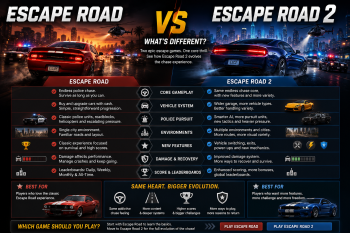
Separate entries can change the environment, vehicles, hazards, and ways the chase develops. For example, Escape Road 2 should be evaluated according to its own mechanics rather than assuming every police behavior works exactly like the original Escape Road.
Keeping those differences separate makes it easier to understand what belongs to the original game and what was introduced or changed elsewhere in the series.
Escape Road Police & Wanted Levels FAQ
Does Escape Road have wanted levels?
Yes. Escape Road is commonly documented with an escalating wanted system that reflects the growing intensity of the police pursuit. Higher pressure means a more difficult chase and fewer easy escape opportunities.
What is the highest wanted level in Escape Road?
The original Escape Road is commonly documented with five stars as its highest wanted state. Exact timing and behavior should not be assumed to be identical across every browser build or game in the series.
Are there roadblocks in Escape Road?
Yes. Roadblocks can become part of the pursuit and are particularly dangerous because they remove usable routes rather than simply following the player.
Are there helicopters in Escape Road?
Helicopters are associated with higher-pressure pursuit states and help signal that the chase has escalated beyond the basic police response.
Why does Escape Road get harder the longer you survive?
As police pressure increases, more threats can occupy the road, useful routes become harder to preserve, and the player has less time and space to recover from mistakes.