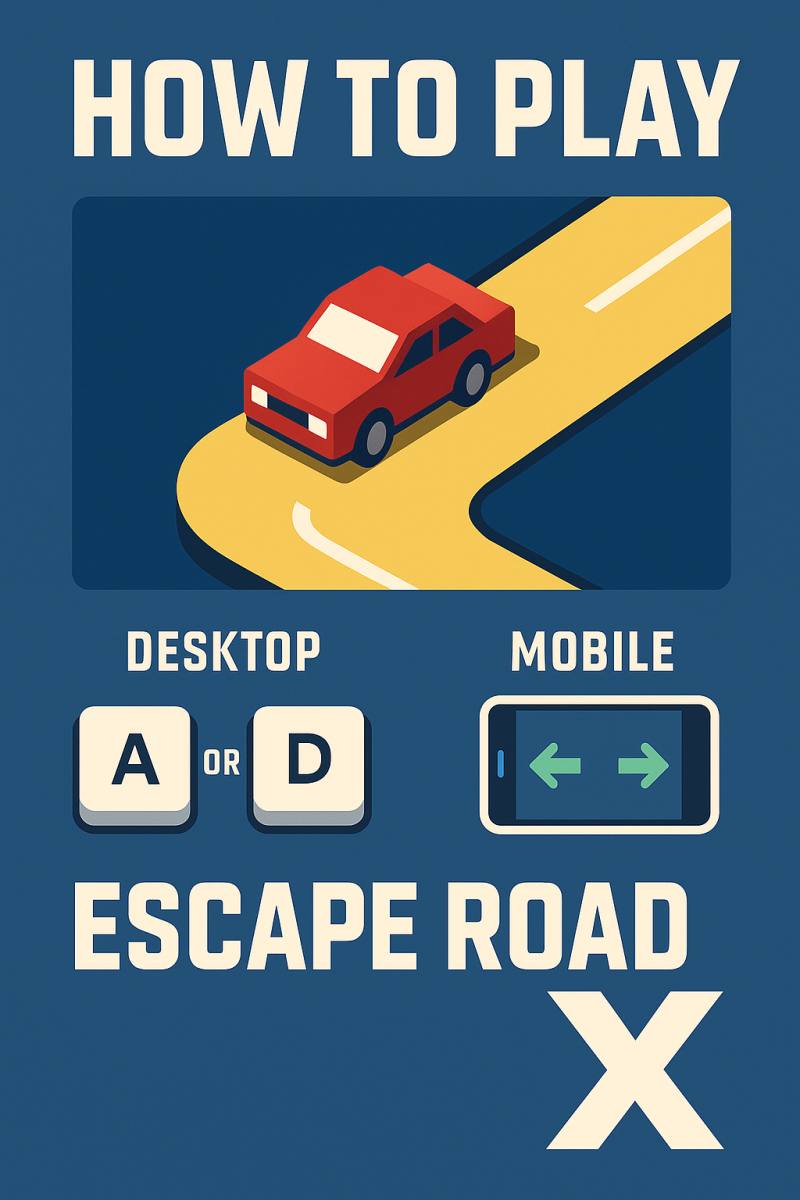
How to Play Escape Road

Escape Road is easy to start but much harder to survive. Your objective is to keep the getaway moving while police vehicles close in, roads become more difficult to use, and every turn changes the shape of the chase.

The key is not simply driving as fast as possible. Strong runs come from controlling the vehicle, reading the road ahead, preserving momentum and choosing routes that leave another escape option available.

If you are ready to play while following this guide, return to Escape Road and use the sections below as a reference.

Escape Road Controls

Escape Road uses a compact driving control system. The exact input prompts can vary slightly between browser builds and devices, so the controls displayed inside the game player should always take priority.

Action Desktop Mobile
Steer Left A or Left Arrow Use the left steering control shown on screen
Steer Right D or Right Arrow Use the right steering control shown on screen
Accelerate W or Up Arrow when manual acceleration is enabled Use the acceleration control if shown
Brake / Reverse S or Down Arrow Use the brake or reverse control shown on screen

Some versions of Escape Road move the vehicle forward automatically. If the current game build auto-accelerates, you do not need to hold an acceleration key; focus instead on steering, braking, route choice and keeping the vehicle under control.

The controls themselves are simple. The difficult part is learning when to use them. A turn made half a second earlier can create an open road, while the same turn made too late can leave the vehicle surrounded.

What Is the Goal in Escape Road?

The objective is to avoid capture and keep the chase alive for as long as possible.

Escape Road is not built around completing a traditional racing circuit. There is no single finish line that solves the run. Instead, the city becomes an open driving space where each road presents another decision.

Your immediate priorities are:

  • keep the vehicle moving;
  • avoid unnecessary collisions;
  • prevent police vehicles from surrounding you;
  • identify usable roads before reaching them;
  • create space whenever the pursuit becomes too close;
  • and recover control quickly after a mistake.

Cash and other rewards can add progression to a run, but survival comes first. A pickup is rarely worth taking if reaching it leaves the vehicle trapped or costs too much momentum.

How to Play Escape Road Step by Step

1. Learn How Your Vehicle Responds

Use the beginning of a run to understand the vehicle before the pursuit becomes crowded.

Pay attention to how quickly the car changes direction, how much space it needs for a turn and how easily momentum is lost after a collision or sharp correction.

The goal is not to perform dramatic turns immediately. Learn the limits of the vehicle first so that later decisions become predictable rather than desperate.

2. Keep the Vehicle Moving

Momentum gives you options.

A moving vehicle can change direction, cross an intersection or create distance from pursuing police. A nearly stationary vehicle has far fewer ways to escape once other cars begin closing the available space.

This is why clean driving often beats reckless speed. Avoid hitting obstacles simply to save a small amount of distance.

3. Look Beyond the Closest Police Car

One of the most common beginner mistakes is watching only the vehicle directly behind you.

The larger danger is often somewhere ahead. Another police vehicle may be approaching an intersection, a road may narrow into a confined area, or an obstacle may remove the route you planned to use.

Shift your attention forward and start making decisions before the immediate threat reaches you.

4. Choose Routes That Leave Another Exit

A good road is not simply one that looks empty now.

Before entering a route, ask what happens after the next few seconds. If the road narrows, ends or removes too many turning options, temporary safety can quickly become a trap.

The strongest routes solve two problems at once: they create distance from the current pursuit and preserve somewhere useful to go next.

5. Use Intersections Before They Become Crowded

Intersections are among the most valuable places in Escape Road because they offer multiple directions.

But that advantage disappears once police vehicles reach the same area. Waiting until the final moment often means several exits have already become unusable.

Approach intersections with a plan. Decide which direction gives you the best combination of space, momentum and future escape options.

6. Avoid Unnecessary Collisions

Not every collision ends a run immediately, but almost every major collision changes the chase in favor of the police.

Impact can reduce speed, rotate the vehicle or leave you facing a poor direction. The seconds spent correcting the mistake give pursuing vehicles time to surround the area.

If two routes are available, the wider and cleaner path is often better than a narrow shortcut that requires a perfect turn.

7. Recover Before Making Another Aggressive Move

After a collision or bad turn, the instinct is often to make another sharp correction immediately.

That can turn one mistake into several.

First straighten the vehicle, regain useful momentum and identify open space. Once the car is stable again, make the next escape decision.

8. Take Rewards Only When the Route Is Safe

Cash and other collectible rewards can make a run more valuable, but they should not replace route awareness.

If a pickup is already along a safe path, take it. If collecting it forces the car into a confined area or directly toward police pressure, keep moving.

The longer the run survives, the more opportunities you will have to collect rewards later.

The Five Skills That Matter Most

Vehicle Control

Good control means making the movement you intended without needing several corrections afterward. Small, early adjustments usually preserve more speed and space than sudden steering at the last moment.

Route Awareness

Do not evaluate only the next few meters of road. Try to understand where the current route is taking you and whether another exit will still exist when you arrive.

Momentum

Momentum is not just speed. It is the ability to keep making useful decisions. Preserve enough movement to turn, escape and recover when the chase changes.

Timing

The difference between a successful turn and a trap is often timing. Make decisions while several options remain instead of waiting until the pursuit forces one choice.

Recovery

No run is perfectly clean. Better players are not only good at avoiding mistakes; they are also better at stabilizing the vehicle after something goes wrong.

How to Survive Longer in Escape Road

As the pursuit grows, stop treating every road as equally useful. Your goal should shift from reacting to individual police vehicles toward managing the entire space around the car.

  • Preserve open space. Avoid allowing the chase to push you against buildings, boundaries or other areas with limited exits.
  • Change direction with a purpose. A turn should create space or improve positioning, not simply make the vehicle harder to follow for one second.
  • Think one route ahead. Before entering the current road, have an idea of where the following escape may come from.
  • Do not chase every reward. Survival creates more opportunities than one risky pickup.
  • Stay calm after contact. Losing control for another second can be more damaging than the collision itself.

The longer you survive, the more valuable anticipation becomes. Early in a run, quick reactions can rescue many situations. Under heavier pressure, the best escape is usually the one you recognized before it became urgent.

Common Escape Road Mistakes

Driving Only by Reaction

If you wait until an obstacle or police vehicle is directly in front of you before making every decision, the available choices will steadily disappear. Look farther ahead and react earlier.

Turning Too Much

Constant direction changes can destroy momentum and make your own path unpredictable. Turn because the road requires it or because the movement creates a clear advantage.

Entering Narrow Areas Without an Exit Plan

A small road may temporarily break the pursuit, but it becomes dangerous when there is no useful way out. Always consider the next route before committing.

Watching Only Behind the Car

The nearest pursuer is visible and distracting, but the next obstacle or approaching police vehicle is often the bigger threat.

Panicking After a Collision

Rapid steering immediately after an impact frequently creates another collision. Stabilize first, then escape.

Prioritizing Cash Over Position

Collecting rewards is useful only while the run remains alive. Do not sacrifice a strong escape route for a pickup positioned in a dangerous area.

How to Get Better at Escape Road

Beginner: Stay in Control

At first, focus on clean steering and avoiding obvious collisions. Learn the response of the vehicle and practice entering turns without losing unnecessary momentum.

Intermediate: Start Planning Routes

Once basic control feels natural, begin looking beyond the next turn. Pay attention to intersections, wider roads and areas where the pursuit could close around you.

Your goal at this stage is to stop choosing routes only because they are immediately open.

Advanced: Control the Shape of the Chase

At a higher level, Escape Road becomes less about escaping the nearest police car and more about influencing where the pursuit develops.

Use direction changes to draw pursuing vehicles away from useful roads. Preserve intersections until you need them. Avoid entering areas where multiple police vehicles can approach from different directions.

The shift from reaction to anticipation is the biggest improvement a player can make.

Route Selection: A Simple Decision Rule

When several roads are available and you have only a moment to choose, evaluate them in this order:

  1. Is the route open now?
  2. Can I enter it without a major collision or loss of control?
  3. Will it preserve momentum?
  4. Does it have another usable exit?
  5. Where will the police be when I reach that exit?

You will not have time to consciously answer all five questions during every chase. With practice, however, this evaluation becomes part of how you read the road automatically.

Does the Same Strategy Work Across the Escape Road Series?

The different Escape Road games use their own settings and variations, but the central skills remain closely related: vehicle control, awareness, route selection, momentum and recovery.

The main numbered games, City branch and seasonal entries may change the environment or presentation, so the safest strategy is to learn each version's handling rather than assuming every vehicle and road behaves identically.

Visit Escape Road Games to explore the complete series and move between the available versions.

Ready for Another Escape?

The fastest way to improve is to put the strategy into practice. Focus on one skill at a time: first clean vehicle control, then route awareness, then anticipating the pursuit before it reaches you.

Play Escape Road and see how much longer you can keep the chase alive.