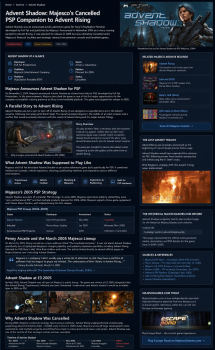
Advent Shadow: Majesco's Cancelled PSP Companion to Advent Rising
Advent Shadow was an unreleased action-adventure game developed by Full Fat and announced by Majesco for Sony's PlayStation Portable. Revealed in November 2004, the game was designed specifically for the PSP and was intended to tell a parallel story within the science-fiction universe established around Advent Rising.
Rather than serving as a handheld port of Advent Rising, Advent Shadow introduced its own protagonist, mercenary pilot Marin Steel, while connecting her story with Gideon Wyeth and the larger Advent narrative. Majesco continued to promote the project into 2005, including within its PSP lineup around E3, but the game ultimately disappeared from the release schedule and was cancelled.
This page preserves the historical Advent Shadow entity and the context associated with its former MajescoGames.com product record. It forms part of the Majesco Games Archive.
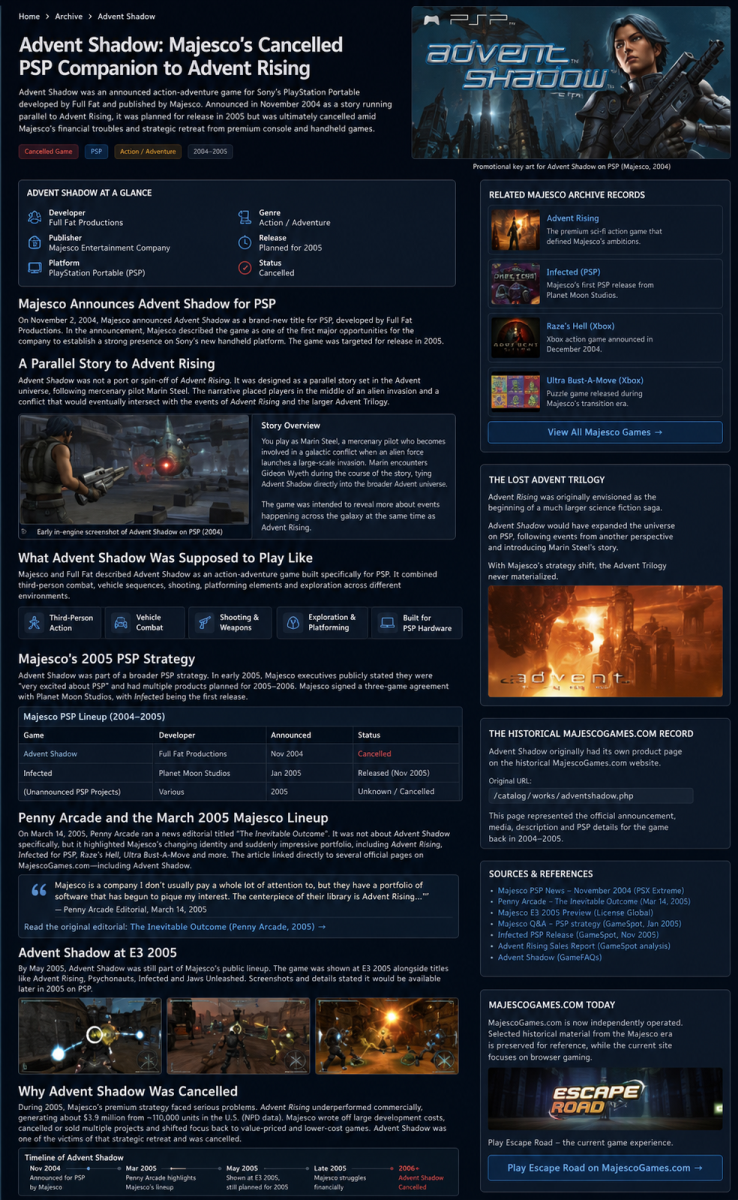
Advent Shadow: the cancelled Majesco-published PSP companion project to Advent Rising, originally announced in 2004.
Advent Shadow at a Glance
| Title | Advent Shadow |
|---|---|
| Developer | Full Fat |
| Publisher | Majesco |
| Platform | PlayStation Portable (PSP) |
| Genre | Action-adventure / third-person action |
| Announced | November 2004 |
| Original Release Window | 2005 |
| Protagonist | Marin Steel |
| Related Game | Advent Rising |
| Final Status | Cancelled / unreleased |
Majesco Announces Advent Shadow for PSP
Majesco announced Advent Shadow in November 2004 as one of its earliest projects for Sony's then-new PlayStation Portable. Contemporary announcements identified Full Fat as the developer and described the title as an entirely new game created specifically for PSP rather than a conversion of an existing console release.
The timing is significant. Sony's PSP represented a new premium handheld platform, and Majesco was attempting to establish a presence early in its lifecycle. Advent Shadow connected that hardware opportunity with one of Majesco's most ambitious properties: the Advent science-fiction universe.
Majesco's announcement positioned the PSP's technical capabilities as suitable for bringing the cinematic presentation associated with the Advent projects to a handheld device. The company expected Advent Shadow to become an early opportunity to establish itself on the platform.
This places Advent Shadow at an important intersection in Majesco's history: the expansion of its premium game portfolio and its effort to participate in a new generation of portable gaming hardware.
A Parallel Story to Advent Rising
Advent Shadow was not announced as a portable version of Advent Rising. Its story was intended to run parallel to the broader Advent narrative while following a different central character.
Players would control Marin Steel, a mercenary pilot whose story begins during a hostile negotiation. The situation changes dramatically when an alien invasion threatens the planet and forces Marin into a much larger conflict.
During her attempt to escape, Marin encounters Gideon Wyeth, the protagonist of Advent Rising. That meeting connected the PSP story directly with events and characters from the main Advent storyline without simply reproducing Gideon's adventure.
The concept gave Majesco a way to expand the fictional universe horizontally. Advent Rising could tell Gideon's story on Xbox and PC while Advent Shadow explored events occurring elsewhere in the same conflict from Marin's perspective.
Marin Steel and the Advent Shadow Story
Historical descriptions present Marin Steel as a mercenary pilot who becomes trapped in events far larger than the mission she initially intended to complete.
A planetary invasion interrupts her attempt to leave a dangerous negotiation. The attackers are depicted as hostile alien forces threatening humanity itself, pushing Marin into a struggle for survival before her path intersects with Gideon Wyeth.
The storyline also involved Marin discovering latent abilities within herself. That element linked her character conceptually with the larger themes of extraordinary human powers and alien conflict surrounding Advent Rising.
Because Advent Shadow never reached commercial release, the complete story was never presented to players. What survives is primarily the premise described in Majesco-era promotional material and contemporary coverage.
What Advent Shadow Was Supposed to Play Like
Although the game was never completed for retail release, contemporary previews provide a useful picture of its intended design.
Advent Shadow was described as a third-person action-adventure title combining several types of gameplay rather than relying on a single combat system. Preview material associated the project with shooting, close-range combat, platforming, vehicle sequences and other action-oriented sections.
Vehicles were expected to form part of the game, while Marin would have access to conventional weapons as well as abilities developed through the story.
This varied design echoed the broader cinematic ambitions surrounding the Advent property. Majesco and Full Fat were attempting to produce a portable title with enough mechanical variety to feel like a distinct entry in the same science-fiction universe rather than a simplified handheld companion.
Designed Specifically for the PlayStation Portable
The PSP relationship is central to understanding Advent Shadow.
The project was announced as an original PSP game at a time when publishers were still determining what Sony's new handheld could support. Majesco was not simply bringing one of its existing games to another platform; it was building a new Advent story around the handheld.
That made Advent Shadow strategically useful in two ways. It expanded the Advent property while simultaneously giving Majesco an original title for Sony's new platform.
Contemporary announcements repeatedly emphasized that the game had been designed specifically for PSP. Historical database records continue to identify Full Fat as developer, Majesco as publisher and PSP as the intended platform.
Majesco's 2004–2005 PSP Strategy
Advent Shadow did not exist in isolation. During 2004 and 2005, Majesco was assembling a wider portfolio for PSP while expanding aggressively across console and handheld gaming.
One of the clearest companion examples is Infected, a third-person PSP shooter developed by Planet Moon Studios. Unlike Advent Shadow, Infected ultimately reached commercial release.
By E3 2005, Majesco's announced portable lineup included multiple PSP and Nintendo DS projects. Advent Shadow remained visible alongside titles such as Infected and other handheld products, demonstrating that the project had progressed beyond an initial announcement and remained part of Majesco's public lineup into 2005.
| Project | Developer | Platform | Historical Outcome |
|---|---|---|---|
| Advent Shadow | Full Fat | PSP | Cancelled |
| Infected | Planet Moon Studios | PSP | Released |
| Guilty Gear Judgment | Arc System Works | PSP | Released |
The surviving lineup helps place Advent Shadow within a real publishing strategy rather than treating it merely as an isolated cancelled game.
Penny Arcade and the March 2005 Majesco Lineup
A useful piece of historical context survives through Penny Arcade's March 14, 2005 publication titled The Inevitable Outcome. Multiple Penny Arcade domain variants and archival mirrors from that publication have historically linked back into MajescoGames.com.
The backlink trail is significant because it connects contemporary gaming commentary directly with Majesco's official web presence at a time when the publisher's lineup was receiving increased attention. Historical link records from this page family point toward several Majesco game pages, including Advent Shadow, Infected, Raze's Hell and Ultra Bust-A-Move.
These links should be understood as one editorial context replicated through multiple Penny Arcade URL variants rather than as a dozen separate independent endorsements.
For Advent Shadow, however, the context is particularly useful. The link appeared while Majesco was actively promoting both the larger Advent project and its PSP plans, providing evidence that the official Advent Shadow page was being discovered and referenced externally while the game was still an active project.
Advent Shadow at E3 2005
Advent Shadow was still part of Majesco's public lineup in May 2005.
Ahead of E3 2005, Majesco announced a broad showcase built around games, gadgets and video products. Advent Shadow appeared among the company's handheld titles alongside Infected, Nanostray, Guilty Gear projects and other PSP and Nintendo DS software.
Contemporary E3 coverage continued to describe Advent Shadow as a PSP project running parallel to the Advent storyline. Preview coverage from May 2005 also discussed gameplay concepts including action sequences, vehicles, shooting, platforming and close combat.
This matters historically because it establishes that Advent Shadow survived well beyond its November 2004 reveal. Roughly six months later, Majesco was still presenting it publicly as part of its future product lineup.
The Advent Universe Majesco Was Trying to Build
Advent Rising was originally promoted as the beginning of a much larger science-fiction property. The plan extended beyond a single console game, and Advent Shadow demonstrates how Majesco intended to expand that universe across platforms and perspectives.
Instead of retelling Advent Rising on PSP, Advent Shadow would have shown another part of the conflict through Marin Steel. Her meeting with Gideon Wyeth would connect the narratives while allowing the portable game to retain a distinct identity.
That structure is one reason Advent Shadow remains historically interesting despite never being released. It preserves evidence of how expansive Majesco's original ambitions for the Advent property had become by late 2004.
What Happened to Advent Shadow?
The answer is tied to a much larger turning point in Majesco's history.
During fiscal 2005, Majesco experienced weak sales across multiple product lines. Its annual report documented a sharp decline in revenue, substantial impairment charges and an operating loss while management reevaluated the company's more expensive publishing strategy.
Majesco had spent the preceding years expanding into capital-intensive premium console games. Those products required larger development and marketing budgets and therefore needed significantly stronger sales to recover their costs.
By the second half of fiscal 2005, management began selling rights to or cancelling projects and shifted the company's strategy toward lower-cost products and handheld games.
Advent Rising itself failed to meet its commercial expectations. Later reporting using NPD data stated that Majesco generated approximately $3.9 million from 110,517 U.S. sales of Advent Rising. GameSpot subsequently identified the planned PSP spin-off Advent Shadow as one of the projects cancelled following Advent Rising's disappointing performance.
Because Majesco's corporate filings describe a portfolio-wide strategic retreat rather than giving a detailed cancellation narrative for Advent Shadow specifically, it is more accurate to treat the project's disappearance as part of that broader financial and publishing context instead of assigning the cancellation to a single event.
Advent Shadow Was Never Released
Advent Shadow ultimately remained an unreleased project. Modern historical databases identify its release status as cancelled and continue to preserve its platform, developer and publisher relationships.
That distinction is important. Advent Shadow should not be treated as a commercially released PSP title merely because screenshots, previews, promotional descriptions and an official product page once existed.
Its historical status is:
- Announced: yes
- Publicly promoted: yes
- Shown during the 2005 promotional cycle: yes
- Developed for PSP: yes
- Commercially released: no
- Final status: cancelled
Advent Shadow Timeline
| Period | Historical Event |
|---|---|
| November 2004 | Majesco announces Advent Shadow for PSP, developed by Full Fat and planned for release in 2005. |
| March 2005 | Contemporary Penny Arcade link records reference Majesco's official game pages during the publisher's expanding 2005 lineup. |
| May 2005 | Advent Shadow remains part of Majesco's E3 2005 PSP lineup and receives additional preview coverage. |
| Second half of 2005 | Majesco encounters weak product sales and begins restructuring its publishing strategy. |
| 2005–2006 period | Majesco sells rights to or cancels multiple projects as it reduces exposure to expensive premium development. |
| Final outcome | Advent Shadow is cancelled and never receives a commercial PSP release. |
The Historical MajescoGames.com Advent Shadow Record
Advent Shadow once had its own product presence within the historical MajescoGames.com website. Surviving backlink records identify an original Majesco URL associated with the title:
http://www.majescogames.com/catalog/works/adventshadow.php
That historical URL represented a specific game entity rather than a generic Majesco catalog page. External references from the period linked into MajescoGames.com while Advent Shadow was still being promoted as an upcoming PSP release.
For that reason, the present archive preserves Advent Shadow as its own historical record. The objective is not to recreate an old page word for word, but to restore the relationship between the domain, the original game entity, its contemporary external references and the publishing history surrounding it.
The wider catalog context is available in Majesco Games: Historical Catalog and Publishing Archive, while contemporary company announcements are documented in the Majesco Press Archive.
Related Majesco Historical Records
Advent Shadow belongs to a particularly active period in Majesco's publishing history. Related archive records include:
- Infected — Planet Moon's PSP shooter released by Majesco in 2005.
- Raze's Hell — an Xbox action game from Majesco's premium publishing period.
- Psychonauts — Double Fine's game published by Majesco during the same expansion era.
- Majesco Q1 2005 Results and Advent Rising Delay — a corporate record documenting Majesco's release schedule during the period.
- Historical Majesco Game Catalog — the broader publishing catalog.
Historical Sources and Surviving References
The surviving Advent Shadow record can be reconstructed from contemporary announcements, previews, database records and Majesco's later corporate reporting. Important sources include Majesco-era announcement coverage from November 2004, E3 2005 product listings, historical PSP database records, Majesco's fiscal 2005 SEC filing and later reporting on the commercial outcome of Advent Rising.
The Penny Arcade URL family is useful primarily as evidence of a contemporary external link into the historical MajescoGames.com game pages. It should not be counted as multiple independent editorial sources simply because the same publication survives through several news, comic and subdomain variants.
Preserving Advent Shadow in the Majesco Games Archive
Cancelled games are easy to lose from the historical web because official product pages often disappear once development stops. Advent Shadow is a strong example: the game never reached retail, yet enough independent evidence remains to reconstruct what the project was, who was developing it, how Majesco positioned it and where it fit within the company's 2004–2005 publishing strategy.
Preserving that distinction allows Advent Shadow to remain connected to the historical Majesco entity without incorrectly presenting it as a finished or commercially released game.
For more preserved games, announcements and products from the earlier MajescoGames.com era, visit the Majesco Games Archive.
MajescoGames.com Today
MajescoGames.com is now independently operated. Selected records from the domain's earlier Majesco era are preserved for historical reference, while the current website focuses on browser gaming with Escape Road as its primary game experience.
Explore Escape Road on MajescoGames.com to visit the current gaming experience.