Psychonauts: From Microsoft Cancellation to Majesco's 2005 Release
Psychonauts was the debut game from Double Fine Productions, the studio founded by former LucasArts designer Tim Schafer. Developed over more than four years, the imaginative action-platformer followed Razputin, a young psychic who runs away from the circus and enters Whispering Rock Psychic Summer Camp in hopes of becoming a Psychonaut.
The game is remembered today as a cult classic, but its path to release was unusually uncertain. Microsoft originally backed Psychonauts as an Xbox project, then ended its publishing agreement with Double Fine in 2004 while the game was still unfinished. Several months later, Majesco acquired the publishing rights and gave the project a new commercial path, ultimately releasing Psychonauts for Windows and Xbox in April 2005 and later for PlayStation 2.
That distinction is essential to the historical record. Double Fine created Psychonauts. Tim Schafer led its creative development. Majesco's role was publishing and bringing the finished project to market after the original Microsoft publishing relationship ended. GameSpot's August 2004 report documents the transition to Majesco, while Double Fine's current game page preserves the studio's own description of the title and its April 19, 2005 release.
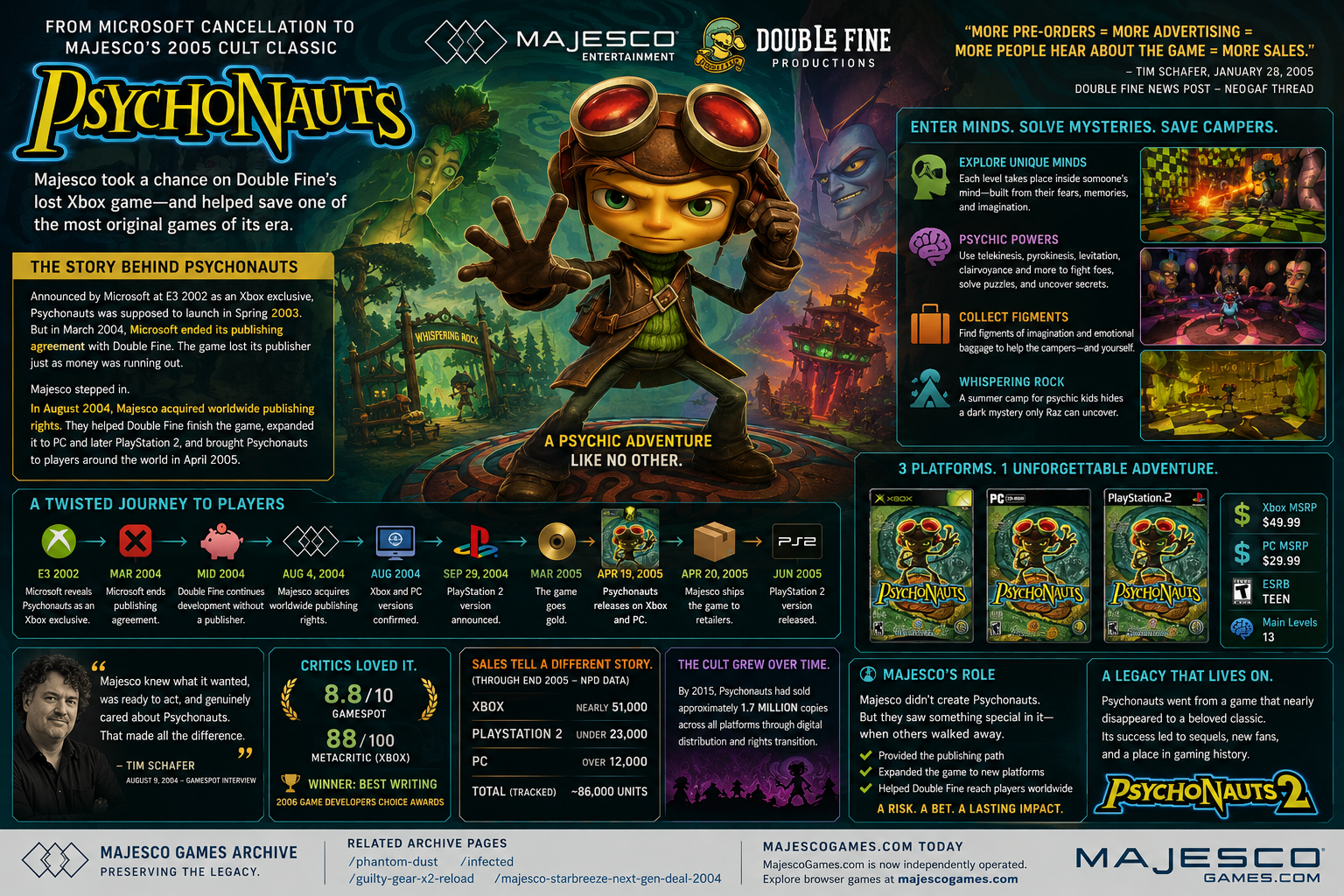
Modern archive illustration representing Psychonauts and Majesco's 2005 publishing period. This is a contemporary archival reconstruction, not original Double Fine or Majesco promotional artwork.
Psychonauts at a Glance
| Title | Psychonauts |
|---|---|
| Developer | Double Fine Productions |
| Creative Director | Tim Schafer |
| Original Planned Publisher | Microsoft Game Studios |
| 2005 Publisher | Majesco |
| Original Platforms | Windows, Xbox, PlayStation 2 |
| Windows / Xbox Release | April 2005 |
| PlayStation 2 Release | June 2005 |
| Genre | 3D platformer / action-adventure |
| ESRB Rating | Teen |
| Players | Single-player |
| Original Development Length | Approximately 4.5 years |
| Reported Development Budget | Approximately $11.8 million |
The development-length and budget figures come from Double Fine's later development postmortem, preserved by Game Developer. Release data and original platform information are independently preserved by GameFAQs.
Double Fine's First Game
Psychonauts began as the first major project from Double Fine Productions, founded by Tim Schafer in 2000 after his years at LucasArts.
Schafer had already built a reputation through adventure games including Day of the Tentacle, Full Throttle and Grim Fandango. Psychonauts moved into a different format: a third-person 3D platformer built around psychic powers, exploration and entering the minds of other characters.
The game's official credits identify Schafer as Creative Director, with Erik Robson as lead designer, Scott Campbell as art director and Peter McConnell composing the music. Story and dialogue credits include Schafer and Erik Wolpaw. MobyGames' preserved Windows credits document the Double Fine development team as well as Majesco's publishing, marketing, QA and packaging staff.
The distinction is particularly important for this archive: Majesco did not originate the creative concept or operate the core development studio. Psychonauts was fundamentally a Double Fine production.
A Platformer Built Inside People's Minds
The central idea of Psychonauts was unusually suited to Double Fine's emphasis on characters and storytelling.
Players control Razputin, or Raz, a gifted young psychic who sneaks into Whispering Rock Psychic Summer Camp, a training facility for future Psychonauts — psychic agents able to enter the minds of other people.
As the story develops, Raz discovers that fellow campers are losing their brains and begins investigating a larger conspiracy. His abilities include powers such as telekinesis, levitation, clairvoyance and other psychic techniques used for both traversal and puzzle solving.
Many of the game's most distinctive stages take place inside individual minds. Instead of treating every level as a conventional physical location, Double Fine could build environments around personality, memory, trauma, obsession and distorted perception.
Double Fine's official Psychonauts page continues to describe the game as a psychic journey through the mental worlds of misfits, monsters and mind readers.
Microsoft Originally Planned to Publish Psychonauts
Psychonauts did not begin as a Majesco project.
The game was initially associated with Microsoft Game Studios and was planned around Xbox. Microsoft financed much of the early development and acted as the project's intended publisher while Double Fine built the game.
The relationship lasted for years, but development became longer and more expensive than originally expected.
A later Double Fine postmortem described the project as approximately four and a half years in development with an $11.8 million budget. It also describes a difficult development process involving repeated redesign, production problems and periods when the future of the studio itself was uncertain.
In early 2004, Microsoft decided to discontinue its publishing agreement.
GameSpot's contemporary report preserves Microsoft's statement that it had ended its publishing relationship with Double Fine while still expressing support for the game's vision and Double Fine's search for another publisher.
Psychonauts Suddenly Needed a New Publisher
The end of the Microsoft agreement created a serious problem.
Psychonauts was not a concept looking for its first round of financing. Double Fine had already spent years developing the game. A substantial portion of the project existed, but the studio still needed the money and publishing infrastructure required to complete and release it.
Double Fine's later postmortem describes Microsoft as having funded years of development before deciding not to underwrite the remaining work. The studio suddenly had to find another route to market while continuing to support a team built around a single large project.
The game's history therefore differs from titles Majesco licensed after development had essentially concluded. Majesco's Psychonauts agreement became part of the mechanism that allowed Double Fine to finish its first game and bring it into retail distribution.
Majesco Acquires Psychonauts
By August 2004, the project's situation changed again.
Majesco announced that it had secured publishing rights to Psychonauts, initially confirming releases for Xbox and Windows PC.
A surviving copy of the original announcement reproduced in a August 2004 NeoGAF thread preserves the Business Wire language describing Majesco as having secured worldwide publishing rights to the Double Fine game.
GameSpot independently reported the same change and noted that a Psychonauts trailer shown around the G-Phoria event carried the Majesco logo. Read GameSpot's August 4, 2004 report.
The historical roles were therefore:
Double Fine Productions → developer and creator
Microsoft Game Studios → original publishing partner during development
Majesco → new publisher that brought the game to market in 2005
Majesco Expanded Psychonauts Beyond Its Original Xbox Path
The Majesco agreement also changed the platform story.
Psychonauts had originally been closely associated with Xbox. After Majesco took over publishing, the commercial plan expanded to include Windows and PlayStation 2.
In September 2004, Majesco confirmed a PlayStation 2 edition in addition to the Xbox and PC versions. GameSpot's announcement records the expansion from the earlier Xbox-centered publishing arrangement.
The PlayStation 2 conversion involved Budcat Creations. Double Fine remained the developer and creative source of Psychonauts, while Budcat assisted with the PS2 port. The surviving credits preserved by MobyGames identify the Budcat team separately from Double Fine and Majesco.
That multiplatform expansion was one of the clearest practical consequences of the transition to Majesco.
January 2005: Preorders, Box Art and an Anxious Fan Base
By January 2005, Psychonauts was finally approaching a release that had been delayed for years.
The NeoGAF thread supplied with this archive provides a useful snapshot of the atmosphere around the game at that moment. On January 29, users discussed an April 19 release date, the newly visible box art and Tim Schafer's increasingly direct appeals for fans to preorder the game.
The January 2005 NeoGAF discussion preserves material quoted from Double Fine's contemporary site, where Schafer humorously urged supporters to preorder and argued that early orders could influence how much marketing the game received.
The thread is particularly valuable as community evidence because it records uncertainty as well as enthusiasm. Some users were already committed because of Schafer's previous work; others remained cautious precisely because Microsoft had abandoned the original publishing deal.
It also captures discussion around the $49.99 console price and the box art Majesco would use to bring an unconventional game to a broader retail audience.
Those reactions should not be treated as authoritative evidence about why Microsoft left the project or how Majesco financed development. They are useful for something different: preserving how players were talking about Psychonauts before reviews and final retail sales could shape its reputation.
Psychonauts Finally Reaches Certification
After years of uncertainty, the game reached its final production milestones in April 2005.
On April 8, Double Fine announced that the Xbox version had passed Microsoft's certification process and that the PC version had already gone gold. The studio's tone reflected how difficult the development had been: finishing the game was treated almost as an improbable victory.
Double Fine's April 8, 2005 archive post survives as a first-party record from the development team itself.
Eleven days later, on April 19, Double Fine posted again to say the game had shipped. Double Fine's launch-day post preserves that moment from inside the studio.
The 2005 Majesco Release
Psychonauts reached the market in April 2005 after a development cycle that had lasted more than four years and crossed two publishing relationships.
GameSpot records the first release as April 19, 2005 and reported on April 20 that Majesco had announced shipment of the Xbox and PC editions. The Xbox version carried a $49.99 suggested retail price, while the PC edition was priced at $29.99. GameSpot's launch report documents the release and the long path that preceded it.
The PlayStation 2 edition followed in June. GameSpot's June 2005 report noted that the PS2 version had started later and therefore did not launch alongside Xbox and PC.
For Majesco, Psychonauts was firmly positioned as a premium title, not as one of the company's sub-$20 value releases.
Critical Reception Was Far Stronger Than Initial Sales
Psychonauts received strong reviews.
GameSpot awarded the original release 8.8/10, praising its storytelling, characters, presentation and the way the psychic theme transformed otherwise familiar platforming mechanics. Read GameSpot's April 2005 review.
The critical response did not immediately translate into equivalent retail performance.
By late June 2005, disappointing sales of both Psychonauts and Advent Rising had become part of analyst concern surrounding Majesco. GameSpot reported that Majesco shares fell after a downgrade tied in part to the weak retail performance of those premium releases. GameSpot's June 2005 financial report documents that early commercial disappointment.
That contrast — enthusiastic reviews but weak launch-period sales — became one of the defining elements of Psychonauts' later cult-classic reputation.
Psychonauts and Majesco's Premium-Game Strategy
The game also belongs to a larger corporate story.
During 2004 and early 2005, Majesco had been moving beyond its traditional value-price business toward more expensive premium console development and publishing. Psychonauts became one of the projects most closely associated with that shift.
Majesco's fiscal 2005 Form 10-K later classified Psychonauts among its premium titles and explicitly described the property as one of the externally owned IPs Majesco licensed rather than owned. The same filing identifies Double Fine Productions among the independent development studios with which Majesco worked. View Majesco's SEC filing.
The distinction supports the historical relationship established throughout this page:
Psychonauts was Double Fine's intellectual and creative property; Majesco acquired publishing rights to commercialize the game.
The contemporary corporate context is reconstructed in more detail in Majesco Q1 2005: Record Revenue & Advent Rising Delay, which places Psychonauts alongside the rest of Majesco's unusually ambitious 2005 release schedule.
Psychonauts, Phantom Dust and Majesco's Microsoft Opportunities
Psychonauts also has an interesting historical parallel inside Majesco's Xbox catalog.
Phantom Dust was developed inside Microsoft Game Studios Japan but did not receive a North American Microsoft publishing release. Majesco acquired the North American publishing rights and brought it to U.S. retail in 2005.
Psychonauts followed a different contractual path — Double Fine owned its IP and Microsoft had been funding and publishing the project before terminating the agreement — but the broader pattern is notable.
In both cases, Majesco identified an unusual Xbox project whose original Microsoft publishing path had broken down and found a way to bring the game to market under Majesco's own publishing operation.
The comparison helps explain why these titles sit naturally beside each other in the archive even though their development and ownership histories were different.
Psychonauts Beside Raze's Hell
Another useful comparison is Raze's Hell, which reached Xbox at almost exactly the same time.
Raze's Hell was created by Artech Studios and published by Majesco as an Xbox exclusive. Psychonauts came from Double Fine after years of Microsoft-backed development and expanded to three platforms under Majesco.
The two games illustrate how diverse Majesco's publishing relationships had become by spring 2005. The company was not working from a single development model: it could fund and publish externally created games, acquire publishing rights to projects whose previous agreements had ended, and build a premium catalog around distinctive independent studios.
A Long Development Cycle Left Its Mark
Psychonauts' unusual quality cannot be separated completely from its difficult development history.
A Double Fine postmortem later described a project lasting approximately 4.5 years, with a reported development budget of about $11.8 million and a peak internal team of 42 full-time developers plus contractors.
The same postmortem is unusually candid about what went wrong: the studio struggled with production discipline, changing goals, management problems and the difficulty of transforming Schafer's expansive ideas into a game that could actually ship.
When Microsoft withdrew, Double Fine had finally reached a more productive phase but had lost the publisher that had financed most of the journey. Majesco's involvement therefore arrived at one of the project's most consequential moments.
The Game Developer postmortem remains one of the strongest retrospective sources for understanding the production itself.
Majesco's Rights Were Publishing Rights, Not Ownership of Psychonauts
The later history of the game makes the original relationship even clearer.
Double Fine retained ownership of the Psychonauts intellectual property. Majesco held publishing rights to the original game under its agreement with the studio.
In 2011, those publishing rights reverted to Double Fine. Game Developer's 2011 report documented the change and clarified that the underlying IP had belonged to Double Fine throughout.
This distinction is historically important because phrases such as “Majesco's Psychonauts” can otherwise imply ownership that never existed. Majesco was the publisher responsible for the game's original commercial release; Double Fine was and remained the creator and IP owner.
The Cult Classic Eventually Found Its Audience
Psychonauts' initial commercial disappointment did not define its long-term performance.
After publishing rights returned to Double Fine, the studio expanded digital distribution and brought the game to additional platforms. Over time, sales grew far beyond the launch-period numbers that had disappointed Majesco and financial analysts in 2005.
A later SEC filing connected with the financing of Psychonauts 2 stated that the original game had surpassed one million cumulative sales. The filing specifically noted that early sales had been low and that performance improved after Double Fine obtained the distribution rights and expanded its digital publishing strategy. View the later SEC record.
That long-tail success transformed the meaning of the original 2005 release. A game that initially became evidence of the risks in Majesco's premium strategy eventually developed into the franchise that justified Psychonauts 2 and became central to Double Fine's identity.
Why Psychonauts Belongs in the Majesco Games Archive
Psychonauts is one of the strongest examples of why a historical publishing archive needs to distinguish creation from publication.
The documented chain is unusually clear:
- Double Fine Productions created and developed Psychonauts;
- Tim Schafer served as creative director and co-writer;
- Microsoft originally funded and planned to publish the Xbox project;
- Microsoft ended the publishing agreement before completion;
- Majesco acquired publishing rights in August 2004;
- the project expanded beyond its original Xbox path;
- Majesco brought the Windows and Xbox versions to market in April 2005 and the PlayStation 2 version followed in June;
- the game was critically acclaimed but initially sold below expectations;
- and publishing rights later reverted to Double Fine, which built a much larger long-term audience through digital distribution.
Majesco's historical role was therefore both limited and consequential. It did not create Psychonauts, but it became the publisher that carried Double Fine's troubled first project through its final development period and into commercial release.
That relationship makes Psychonauts an essential part of the Majesco Games Archive.
Preservation Notes
This page is a modern historical reconstruction of Psychonauts and its relationship with Majesco during the 2004–2005 publishing period.
The historical roles are intentionally separated: Double Fine Productions developed Psychonauts; Tim Schafer led its creative direction; Microsoft Game Studios was the original publishing partner; Majesco later acquired publishing rights and published the original 2005 commercial releases.
The NeoGAF preorder thread is treated as contemporary community evidence. It preserves discussion around the announced release date, preorders, box art and marketing anxiety, but it is not used as authority for ownership, contractual or development claims.
The archive also distinguishes Majesco's temporary publishing rights from ownership of the Psychonauts IP. Double Fine retained the intellectual property, and the original game's publishing rights reverted to Double Fine in 2011.
The image on this page is a modern archive illustration created for the current MajescoGames.com archive. It is not original Psychonauts box art, an in-game screenshot or historical promotional artwork produced by Double Fine, Microsoft or Majesco.
Historical Sources
- GameSpot — Microsoft ends its Psychonauts publishing agreement
- GameSpot — Majesco becomes Psychonauts publisher, August 2004
- NeoGAF — preserved copy of Majesco's August 2004 publishing-rights announcement
- GameSpot — Majesco confirms PlayStation 2 version, September 2004
- NeoGAF — January 2005 preorder, release-date and box-art discussion
- Double Fine Productions — Xbox certification and PC gold status, April 8, 2005
- Double Fine Productions — Psychonauts ships, April 19, 2005
- GameSpot — Xbox and PC launch report, April 2005
- GameSpot — original Psychonauts review
- GameSpot — PlayStation 2 release, June 2005
- MobyGames — original Windows development and Majesco credits
- MobyGames — PlayStation 2 credits including Budcat Creations
- GameFAQs — Xbox release, developer, publisher and rating data
- Game Developer — Double Fine's Psychonauts development postmortem
- U.S. Securities and Exchange Commission — Majesco fiscal 2005 Form 10-K
- Game Developer — publishing rights revert to Double Fine in 2011
- U.S. Securities and Exchange Commission — later Psychonauts sales and publishing-history record
- Double Fine Productions — current official Psychonauts game page
MajescoGames.com Today
MajescoGames.com today is independently operated and should not be confused with Double Fine Productions, Microsoft Game Studios, Majesco Entertainment Company or the other historical organizations involved in the original Psychonauts development and release.
This page preserves the documented relationship between Psychonauts and Majesco's 2004–2005 publishing activity. For the wider historical collection, visit the Majesco Games Archive.
For another unusual Majesco publishing relationship involving a project whose Microsoft publishing path changed, see Phantom Dust. For the broader financial and release context surrounding Majesco's premium-game strategy in early 2005, see Majesco Q1 2005 Results & Advent Rising Delay.
For an explanation of the distinction between the historical Majesco era and the independently operated website that exists today, see About MajescoGames.


