Moonlight Fables: Majesco's Lost Nintendo DS Werewolf Game
Moonlight Fables was supposed to be one of Majesco's first steps into the Nintendo DS era.
Announced before Nintendo's dual-screen handheld had even reached North American stores, the project was a gothic side-scrolling action-adventure starring Trista Silver, a young Strike Force graduate who discovers that she is the unwitting heir to the Wolfen Empire and possesses the power to transform into a werewolf.
Its most distinctive idea connected that transformation directly to Nintendo's new hardware. Majesco planned for players to use the DS touch screen to manipulate the phases of the moon, changing or unlocking Trista's supernatural abilities.
The project also promised a connected world, a mixture of two-dimensional and three-dimensional imagery, dynamic camera movement, weapons ranging from the mystical Moon Sword to blasters, and some form of multiplayer network play.
But Moonlight Fables never reached stores.
By February 2005, reports suggested that development had run into trouble. Majesco publicly maintained that the game was still being developed, but acknowledged that its direction had changed and that the company was evaluating a new approach.
After that, the project disappeared.
Its companion announcement, Nanostray, continued through development and became Majesco's first Nintendo DS game to reach North American retail in July 2005. Moonlight Fables became the other side of that early DS story: an ambitious original concept that remained trapped in the development period.
The historical chain is therefore:
early Nintendo DS planning → Majesco's first DS lineup → Cyber Philharmonic → Trista Silver and the Wolfen Empire → touch-controlled moon phases → development changes direction → planned 2005 release disappears → cancelled game.
This page preserves that lost Majesco project as part of the Majesco Games Archive.
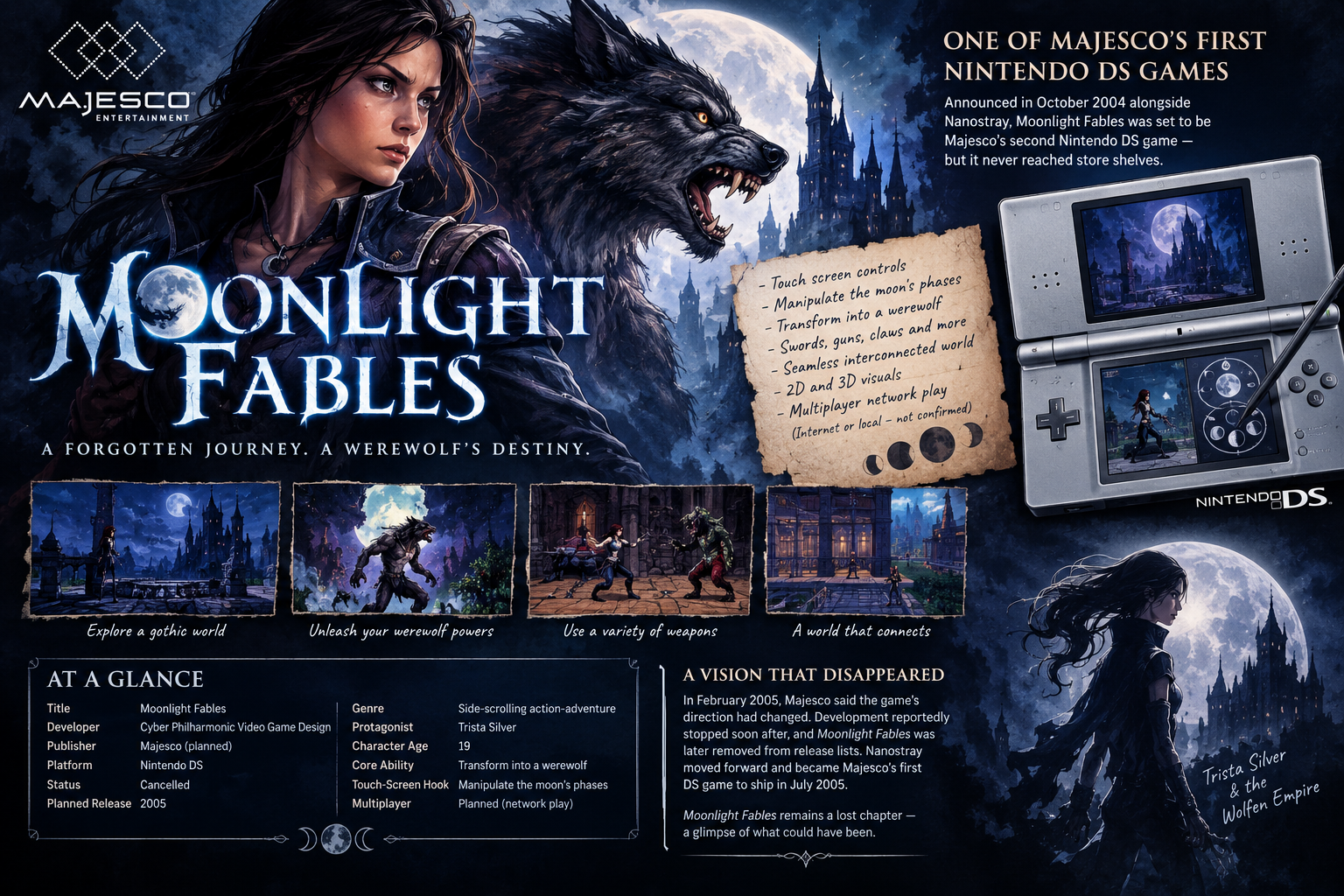
Modern archive illustration representing the planned Moonlight Fables Nintendo DS project, Trista Silver and its touch-controlled werewolf concept. This is a contemporary archival reconstruction, not original Majesco promotional artwork or an image from a finished retail game.
Moonlight Fables at a Glance
| Title | Moonlight Fables |
|---|---|
| Developer | Cyber Philharmonic Video Game Design |
| Planned Publisher | Majesco |
| Platform | Nintendo DS |
| Status | Cancelled |
| Planned Release | 2005 |
| Genre | Side-scrolling action-adventure |
| Protagonist | Trista Silver |
| Character Concept | 19-year-old Strike Force graduate and unwitting heir to the Wolfen Empire |
| Core Ability | Transformation into a werewolf |
| Touch-Screen Mechanic | Manipulate phases of the moon to affect or unlock werewolf powers |
| Known Weapons | Moon Sword, blasters, claws and teeth |
| World Structure | Planned seamless interconnected area with revisitable locations |
| Visual Concept | Combination of 2D and 3D artwork with dynamic camera movement |
| Planned Networking | “Multiplayer network play”; exact online versus local implementation was not confirmed |
Moonlight Fables Was Announced Before the Nintendo DS Reached U.S. Stores
Moonlight Fables appeared unusually early in the history of Nintendo's new handheld.
On August 10, 2004, Nintendo identified it among the third-party Nintendo DS projects being prepared for North America.
The GameSpot report on Nintendo's August 2004 DS software lineup listed Majesco with Moonlight Fables, Nanostray and at least three additional projects in development.
The Nintendo DS would not launch in North America until November 21.
Moonlight Fables therefore belongs to the period when publishers and developers were still deciding what a Nintendo DS game should actually be.
Touch controls, two screens and wireless communication were new design opportunities rather than established conventions.
Majesco was trying to enter that experimental period early.
Moonlight Fables and Nanostray Became Majesco's First DS Pair
On October 1, 2004, Majesco formally announced its first two Nintendo DS titles.
They were:
- Moonlight Fables, designed by Cyber Philharmonic Video Game Design;
- Nanostray, developed by Shin'en.
The original Majesco announcement preserved by Nintendo World Report said both projects were scheduled for 2005 and planned to support touch-screen input, dual-screen functionality and multiplayer network play.
Majesco president Jesse Sutton framed the announcement directly around the new machine's capabilities, highlighting wireless connectivity and touch-screen support as characteristics the publisher wanted its software to exploit.
Chief technology officer Kevin Ray went further, describing Nintendo DS as a broad new design palette and comparing Majesco's intended approach with earlier experiments around Game Boy Advance Video and wireless technologies.
The two games therefore represented more than two additional catalog entries.
They were Majesco's first public statement about how it intended to use Nintendo's next handheld platform.
The Two Early Majesco DS Games Took Very Different Approaches
The pairing was particularly interesting because the projects interpreted the Nintendo DS in completely different ways.
Shin'en's Nanostray was a science-fiction shooter. Its touch screen would be used for functions such as tracking enemies and managing weapons.
Moonlight Fables was a gothic fantasy action-adventure.
Its touch screen was tied to the fiction itself.
The player was supposed to alter the phases of the moon and, by doing so, change Trista Silver's access to her werewolf powers.
That difference makes Moonlight Fables one of the more imaginative early DS concepts in Majesco's historical lineup.
The touch screen was not merely intended to replace a button or display an inventory.
It represented the moon.
Trista Silver Was the Heir to the Wolfen Empire
Majesco gave Moonlight Fables a surprisingly specific protagonist for a project that would ultimately disappear before release.
Trista Silver was described as a recent graduate of a Strike Force officer school and the unwitting heir to the mysterious Wolfen Empire.
GameSpot's October 2004 Moonlight Fables report identified her as 19 years old and described the project as a gothic-fantasy side-scrolling action-adventure.
As the story progressed, Trista was expected to discover that she could transform into a werewolf.
The transformation was not presented as a cosmetic change.
It sat at the center of the game's combat and Nintendo DS interaction.
The Moon Phase Was Supposed to Be a Game Mechanic
The most memorable announced feature was the player's ability to manipulate the moon.
Majesco said the Nintendo DS touch screen would allow players to change the moon's phases and unlock Trista's werewolf powers.
That creates an unusually coherent connection between hardware, fiction and character design:
touch screen → moon phase → werewolf state → available powers and attacks.
For an early Nintendo DS project, this was a meaningful use of the platform's new interface.
The design did not simply ask, “What can the stylus control?”
It asked how the stylus could interact with the mythology of the game's world.
Because the project never reached a finished retail state, it is not possible to document precisely how every moon phase would have affected Trista or how extensively the mechanic had been implemented.
The historical claim should therefore remain limited to what Majesco actually announced: manipulating lunar phases was intended to unlock or affect Trista's werewolf abilities.
Moonlight Fables Mixed the Moon Sword, Blasters and Werewolf Attacks
The surviving game description shows that combat was planned to combine supernatural and technological weapons.
The GameFAQs Moonlight Fables record preserves a description naming:
- the mystical Moon Sword;
- multiple blasters;
- Trista's werewolf claws;
- and her teeth.
The planned world was also said to contain monsters, puzzles and mysteries.
This creates an unusual tonal mixture:
gothic werewolf mythology + swords + firearms + futuristic Strike Force background.
Moonlight Fables was therefore not being conceived as a conventional medieval werewolf story.
Its world mixed supernatural fantasy with more modern or science-fiction-flavored equipment.
The Entire Game Was Supposed to Feel Like One Connected World
Moonlight Fables was nominally a side-scroller, but Majesco's description suggested a more ambitious structure than a sequence of isolated levels.
GameSpot reported that the individual areas were intended to blend together into one large seamless world.
Players would be able to acquire accessories or abilities that allowed Trista to return to previously visited locations and reach items or entrances that had been inaccessible earlier.
That planned structure created a progression loop based on exploration:
enter area → discover inaccessible route → obtain new ability or accessory → return → reach previously blocked content.
The design resembles the interconnected exploration philosophy found in many side-scrolling action-adventure games, although contemporary sources did not formally classify Moonlight Fables with any later genre label.
The safest historical description is simply that Majesco planned a large connected world built around revisiting earlier areas as Trista acquired new capabilities.
A Dynamic Camera Would Blend 2D and 3D Presentation
The visual design was also intended to move beyond a conventional fixed-perspective side-scroller.
Majesco described a combination of two-dimensional and three-dimensional art styles with a camera capable of dynamically zooming toward or away from the action.
The goal appears to have been to retain side-scrolling readability while giving important encounters and environments additional depth and dramatic presentation.
Again, because there is no final retail build, the archive should not treat every announced visual feature as something that reached completion.
What survives is evidence of the intended design.
Moonlight Fables was planned as a hybrid presentation rather than a simple continuation of Game Boy Advance-era 2D graphics.
The Multiplayer Plan Was Real, but Its Exact Form Was Never Clear
Majesco's October announcement said both Moonlight Fables and Nanostray would feature “multiplayer network play.”
That phrase needs to be handled carefully.
GameSpot noted at the time that it was unclear whether Majesco meant Internet-based online multiplayer or local wireless communication between nearby Nintendo DS systems.
Later cancellation archives preserve the same uncertainty.
The correct historical statement is therefore:
Moonlight Fables was announced with multiplayer network play, but surviving contemporary information does not establish whether the planned implementation was Internet-based, local wireless, or a combination of the two.
Calling it an online multiplayer game would go beyond the available evidence.
Cyber Philharmonic Was a Very Different Partner From Shin'en
The two first-wave DS projects also represented different development relationships for Majesco.
Shin'en was already a known quantity.
The German studio had worked with Majesco on the Iridion series, including the much-improved Iridion II.
Cyber Philharmonic Video Game Design had a much smaller public profile.
Majesco was therefore balancing two different types of early Nintendo DS bet:
an established technical partner producing Nanostray
and
a comparatively obscure developer building an original gothic action-adventure in Moonlight Fables.
That contrast becomes especially important when the projects' later histories are compared.
By February 2005, Something Had Changed
For several months after the October announcement, Nanostray continued to receive public updates.
Moonlight Fables did not.
On February 18, 2005, Japanese gaming publication Inside Games reported that a source close to Cyber Philharmonic claimed development had stopped.
Majesco's response was more cautious.
The contemporary Inside Games report records Majesco as saying that Moonlight Fables was still in development, but that the project's direction had changed and that the publisher was examining a new direction for the game.
This distinction matters.
February 2005 is not a reliable date for an official cancellation.
What it documents is a project in trouble or transition.
Original direction → lack of public updates → reports of stopped development → Majesco confirms a change in direction.
Majesco Never Publicly Explained the Redesign in Detail
The surviving record does not reveal precisely what Majesco intended to change.
There is no sufficiently authoritative evidence showing whether the company planned to alter:
- the protagonist;
- the werewolf mechanic;
- the side-scrolling structure;
- the touchscreen moon system;
- the art direction;
- or the entire production model.
Later cancelled-game archives describe a major developmental overhaul, which is consistent with Majesco's contemporary statement that the direction had changed.
But the exact contents of that redesign remain undocumented.
This is one of the most important limits of the historical evidence.
The archive can establish that Moonlight Fables changed direction.
It cannot reconstruct a finished second design that was never publicly documented.
The Exact Reason for Cancellation Remains Uncertain
Later sources classify Moonlight Fables as cancelled, and GameFAQs currently records the planned Majesco release simply as Canceled.
The Unseen64 Moonlight Fables archive also preserves screenshots and surviving information about the abandoned project.
Years after development ended, a commenter claiming to have worked on Moonlight Fables described internal production problems and missed development milestones.
That account is interesting but has not been independently verified as an official developer or Majesco statement.
For that reason, it should not be treated as the established cause of cancellation.
The strongest evidence supports a more limited conclusion:
development encountered enough difficulty for Majesco to reconsider the project's direction in early 2005, and the game was later removed from the commercial release path without ever reaching retail.
Nanostray Became the Majesco DS Game That Moonlight Fables Never Got to Be
The clearest way to understand the loss of Moonlight Fables is to follow what happened to the other game announced beside it.
Nanostray continued development.
Shin'en demonstrated it publicly at E3 2005, refining its touchscreen weapon-management system and 3D presentation.
Then, on July 19, 2005, Majesco shipped Nanostray to retailers in North America.
The GameSpot Nanostray shipment report explicitly described it as Majesco's first Nintendo DS game to reach retail.
The history therefore divides neatly:
October 2004: Moonlight Fables + Nanostray announced together as Majesco's first DS titles.
February 2005: Moonlight Fables changes direction.
July 2005: Nanostray ships and becomes Majesco's first actual DS retail release.
Moonlight Fables: never released.
This makes Nanostray the most important related historical record for Moonlight Fables.
Two Early DS Experiments Produced Opposite Outcomes
The projects also show two different ways of exploiting the DS hardware.
Nanostray used the touch screen primarily as a secondary control and information surface within a familiar shoot-'em-up framework.
Moonlight Fables attempted something more tightly linked to fiction: the lower screen would manipulate lunar phases that influenced the powers of a werewolf protagonist.
One concept was completed.
The other disappeared during development.
That does not prove that Moonlight Fables failed because its design was more ambitious. The available evidence does not establish such a causal relationship.
But together, the two titles capture how experimental Nintendo DS development still was in late 2004.
Publishers were trying different interpretations of touch controls before developers had years of established DS design conventions to follow.
Moonlight Fables Was an Original Majesco Handheld Bet
The project is also notable because it was not built around an established entertainment license.
Moonlight Fables introduced its own:
- protagonist in Trista Silver;
- Wolfen Empire mythology;
- Moon Sword;
- werewolf transformation system;
- and gothic-fantasy world.
That places it alongside a broader period in which Majesco was willing to support distinctive handheld concepts rather than relying only on recognized franchises.
Infected offers an interesting comparison.
Planet Moon's original PSP concept survived development and reached stores in 2005 with its unusual viral multiplayer system.
Moonlight Fables represents the opposite outcome:
an original handheld concept that Majesco publicly backed but never managed to convert into a commercial product.
Moonlight Fables Also Belonged to Majesco's Hardware Experimentation Era
Majesco's interest in unusual Nintendo DS functions did not appear in isolation.
During the preceding Game Boy Advance period, the company had experimented with video cartridges, audio products and wireless accessories in addition to conventional games.
The historical Game Boy Advance Accessories record documents part of that broader willingness to explore what handheld hardware could do beyond standard cartridge gameplay.
When Majesco executives described Nintendo DS as a new design palette in 2004, they explicitly connected that philosophy to earlier Game Boy Advance experiments.
Moonlight Fables was intended to carry that thinking into software:
new screen configuration → touch interaction → wireless functionality → gameplay mechanics designed around the hardware itself.
Why a Cancelled Game Still Belongs in the Majesco Archive
Moonlight Fables has no final review score.
It has no retail sales history.
There is no finished cartridge whose complete mechanics can be documented.
Yet the game remains historically useful because it preserves a strategy that otherwise disappears if the archive includes only successful releases.
Moonlight Fables shows what Majesco thought Nintendo DS software might look like before the company had shipped a single game for the system.
The project reveals:
- an early commitment to Nintendo DS;
- a willingness to fund a new handheld IP;
- a developer partnership with Cyber Philharmonic;
- a touch mechanic built directly around werewolf mythology;
- an interconnected side-scrolling world;
- planned multiplayer networking;
- and a development path that changed direction before disappearing.
Cancelled projects matter because they preserve decisions that finished products cannot show.
Moonlight Fables records a path Majesco considered important enough to announce publicly but ultimately did not complete.
Historical Sources and Surviving References
This reconstruction prioritizes Majesco's contemporary announcement, period GameSpot reporting, the February 2005 report documenting the project's change in direction, and surviving databases that identify Moonlight Fables as cancelled.
- GameSpot — U.S. Third-Party DS Games Revealed, August 10, 2004. Lists Moonlight Fables and Nanostray among Majesco's announced Nintendo DS software before the hardware's North American launch.
- ```
- Nintendo World Report — Majesco Announces First Two Nintendo DS Titles, October 1, 2004. Preserves Majesco's announcement of Moonlight Fables and Nanostray, Cyber Philharmonic's development role, Trista Silver, the Wolfen Empire and the touch-controlled moon-phase mechanic.
- GameSpot — Majesco's First Two DS Titles to Ship Next Year, October 1, 2004. Provides additional contemporary details including Trista's age, 2D/3D presentation, dynamic camera, seamless world structure and uncertainty surrounding the announced multiplayer network play.
- GameFAQs — Moonlight Fables Release Data. Identifies Cyber Philharmonic as developer, Majesco as publisher and the planned Nintendo DS release as cancelled.
- Inside Games — Moonlight Fables Changes Direction, February 18, 2005. Preserves the contemporary report that development had apparently encountered trouble and Majesco's statement that the project remained in development but had changed direction.
- Unseen64 — Moonlight Fables DS Cancelled Archive. Preserves later documentation and surviving information about the abandoned project while retaining the uncertainty around its planned network implementation.
- GameSpot — Majesco Fires Off Nanostray, July 19, 2005. Confirms that the other title announced alongside Moonlight Fables became Majesco's first Nintendo DS game to reach retail.
- ```
Preserving Moonlight Fables in the Majesco Games Archive
Moonlight Fables represents a Majesco game that existed strongly enough to have a title, protagonist, developer, platform strategy, announced gameplay systems and a planned release window — but never strongly enough to become a retail product.
Its history begins during Nintendo DS's pre-launch period.
Majesco selected Moonlight Fables and Nanostray as its first two announced games for Nintendo's new handheld. Cyber Philharmonic planned a gothic action-adventure around Trista Silver, a young officer connected to the Wolfen Empire whose werewolf abilities could be manipulated through the DS touch screen and the phases of the moon.
The design expanded beyond that single hook. Majesco described a seamless world, revisitable areas, mixed 2D and 3D presentation, multiple weapons and network multiplayer.
Then the development trail changed.
By February 2005, Majesco acknowledged that Moonlight Fables had moved in a different direction. No finished redesign emerged publicly. Nanostray continued, reached retail in July and became Majesco's first commercially released Nintendo DS game.
Moonlight Fables did not.
The historical entity chain is therefore:
Cyber Philharmonic → Moonlight Fables → Majesco's first Nintendo DS lineup → Trista Silver → touch-controlled lunar transformations → 2005 development redirection → cancellation.
That lost development path is the specific relationship preserved here within the Majesco Games Archive.
Related historical records include the Majesco Games Historical Catalog, Majesco Press Archive, Nanostray, Iridion II, Infected and Game Boy Advance Accessories.
MajescoGames.com Today
MajescoGames.com is now independently operated. Selected records associated with the domain's earlier Majesco era are preserved for historical reference, while the current website focuses on browser gaming with Escape Road as its primary game experience.
Visit MajescoGames.com to explore the current site.


