Bomberman Jetters: Majesco's 2004 North American GameCube Release
Bomberman Jetters is an action-adventure game developed by Hudson Soft and originally released in Japan for Nintendo GameCube and PlayStation 2 in December 2002. The game combines the gameplay foundation of Bomberman Generation with characters, settings and presentation drawn from the Bomberman Jetters anime series.
Its North American history is particularly relevant to MajescoGames.com. Majesco brought the GameCube version to the United States in 2004, positioning it as an affordable $19.99 release and promoting both its adventure campaign and the four-player multiplayer gameplay traditionally associated with Bomberman.
The relationship survives in more than later database records. Contemporary Majesco press releases directed players to MajescoGames.com, while old guides and community discussions preserved links to multiple MajescoGames.com pages created specifically for Bomberman Jetters.
This page reconstructs that historical game and publishing relationship as part of the Majesco Games Archive.
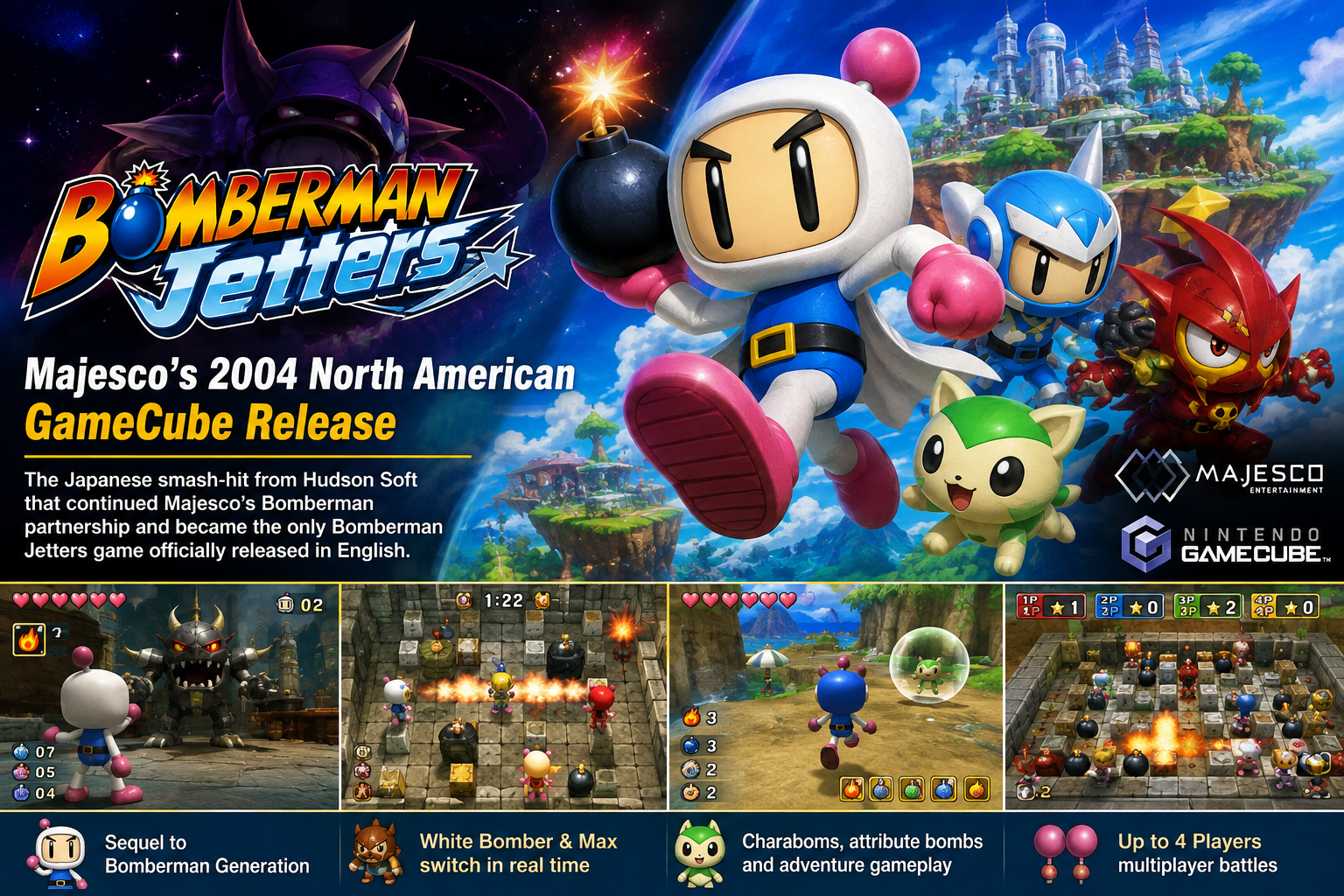
Archive illustration representing Bomberman Jetters and Majesco's 2004 North American GameCube release. This is a modern archival illustration rather than original Hudson Soft or Majesco promotional artwork.
Bomberman Jetters at a Glance
| Title | Bomberman Jetters |
|---|---|
| Developer | Hudson Soft |
| Japanese Publisher | Hudson Soft |
| North American GameCube Publisher | Majesco Sales, Inc. |
| Series | Bomberman |
| Platforms | Nintendo GameCube, PlayStation 2 |
| Japanese Release | December 19, 2002 |
| North American GameCube Release | March 2004 |
| North American Price | $19.99 suggested retail price |
| Genre | Action-adventure |
| Modes | Single-player and local multiplayer |
| North American Platform | Nintendo GameCube |
Before Jetters: Majesco and Hudson's Bomberman Partnership
Bomberman Jetters was not Majesco's first relationship with Hudson Soft or the Bomberman franchise.
In January 2002, Majesco announced an agreement with Hudson Soft to publish three Bomberman products for Nintendo systems in North America. The agreement covered Bomberman Generation for GameCube and the two Game Boy Advance titles Bomberman Max 2: Blue Advance and Bomberman Max 2: Red Advance.
Bomberman Generation subsequently reached North America in June 2002. Its combination of cel-shaded three-dimensional environments, adventure gameplay and traditional multiplayer created much of the mechanical foundation that Bomberman Jetters would later inherit.
The Game Boy Advance side of that earlier publishing relationship is also represented in the archive through Bomberman Max 2: Blue Advance.
By the time Majesco announced Bomberman Jetters for the United States in late 2003, the company was therefore continuing an established North American publishing relationship with Hudson rather than entering the Bomberman franchise for the first time.
From a Japanese Hudson Release to Majesco's North American Edition
Hudson Soft released Bomberman Jetters in Japan for GameCube and PlayStation 2 on December 19, 2002.
The game belonged to a wider group of Bomberman Jetters projects surrounding the Japanese animated series. Hudson released several Jetters-related games in Japan across Game Boy Advance, GameCube, PlayStation 2 and mobile platforms.
The console game was significant because it combined two existing branches of Bomberman history. Mechanically, it followed Bomberman Generation. Narratively and visually, it incorporated characters and ideas associated with the Bomberman Jetters animated property.
Majesco later selected the GameCube edition for North American publication. The PlayStation 2 version remained outside Majesco's North American release.
This makes the historical relationship more precise than simply describing Bomberman Jetters as a “Majesco game”:
Hudson Soft developed the game and originally published it in Japan; Majesco published the GameCube version for the North American market.
Majesco Announces Bomberman Jetters for the United States
On October 2, 2003, Majesco publicly announced that it would publish Bomberman Jetters in the United States.
The company's announcement presented the game as the successor to Bomberman Generation and emphasized its existing success in Japan. Majesco originally planned to ship the GameCube edition during the 2003 holiday period, with November identified as the release target.
The suggested retail price was already set at $19.99.
Majesco marketing executive Ken Gold positioned the game around two audiences: established Bomberman players and GameCube owners who might be attracted by the franchise's multiplayer reputation and relatively low price.
The announcement also directed people seeking more information about Bomberman Jetters or Majesco's broader catalog to MajescoGames.com, providing direct contemporary evidence of the relationship between this game and the historical domain.
The original Majesco announcement is preserved by Nintendo World Report's October 2003 Bomberman Jetters report.
From Holiday 2003 to March 2004: The Delayed U.S. Release
Bomberman Jetters did not arrive during the original November 2003 window.
The surviving public record does not provide enough reliable evidence to assign a specific cause to the delay, so it is better not to speculate about why Majesco moved the date.
What can be established clearly is the timeline.
| Date | Historical Event |
|---|---|
| December 19, 2002 | Hudson Soft releases Bomberman Jetters for GameCube and PlayStation 2 in Japan. |
| October 2, 2003 | Majesco announces the North American GameCube edition. |
| November / Holiday 2003 | Original Majesco release target. |
| March 9, 2004 | Majesco announces that Bomberman Jetters has shipped to North American retailers. |
| March 10, 2004 | Commonly recorded North American retail release date. |
Majesco's March 9 shipment announcement confirmed that the game had finally reached retail while preserving the same $19.99 suggested price announced several months earlier.
The contemporary launch announcement can still be read through Nintendo World Report's preserved Majesco press release.
Why Majesco Priced Bomberman Jetters at $19.99
The $19.99 price was not a later clearance price applied after weak sales. Majesco positioned Bomberman Jetters as an affordable release before the game reached North American stores.
The October 2003 announcement listed a suggested retail price of $19.99, and the March 2004 launch release retained exactly the same price.
Majesco explicitly described the combination of gameplay options and the “attractive price-point” as part of the game's appeal to GameCube owners.
GameSpot likewise reported the game entering the market at $19.99 when Majesco announced shipment in March 2004.
This places Jetters within Majesco's broader history of using value-oriented pricing, although its historical identity should not be reduced purely to a budget-game strategy. Majesco's more important role here was regional publishing: bringing a Hudson-developed Japanese Bomberman title to the North American GameCube market.
The Jetters Game That Reached North America
Bomberman Jetters existed within a larger Japanese media project that extended beyond this single GameCube release.
The Bomberman Jetters television series ran in Japan for 52 episodes between October 2002 and September 2003. Hudson also produced several games connected with the property, including Game Boy Advance titles and the GameCube/PlayStation 2 game.
Among those Jetters video game releases, the GameCube version became the one that received an official English-language North American release through Majesco.
That makes the 2004 Majesco edition historically unusual. For many North American players, it provided an official localized entry point into a Jetters game property that otherwise remained heavily concentrated in Japan.
Later preservation work has produced fan translations of other Japan-only Jetters games, but those projects should be distinguished from Majesco's official 2004 commercial localization.
Part Bomberman Generation Sequel, Part Jetters Anime Game
Bomberman Jetters is easier to understand when viewed as the intersection of two different predecessors.
Its gameplay follows the structure established by Bomberman Generation. Players explore three-dimensional areas, solve environmental puzzles, create different bomb types, collect and develop Charaboms, fight bosses and unlock additional content.
At the same time, Jetters adopts characters, story concepts and visual presentation connected with the animated series.
Contemporary GameSpot coverage described the game as Hudson's sequel to Bomberman Generation while noting the heavier anime-style story and the addition of another playable character.
The result is neither simply a traditional Bomberman battle game nor a straightforward retelling of the television series.
It is a Bomberman Generation-style action adventure reconstructed around the Jetters setting.
The Dark Star Threat to Planet Bomber
The single-player story centers on a plan by Mujoe and the Hige Hige Bandits to destroy Planet Bomber.
Their weapon is the Dark Star, an artificial comet placed on a collision course with Bomberman's home world.
Bomberman must enter the Dark Star and shut down the four engines propelling it before the artificial comet reaches Planet Bomber.
The campaign is consequently structured around four major worlds associated with those engines. Each world contains multiple stages, environmental obstacles, enemies, puzzles and boss encounters.
GameSpot's 2004 review described six stages within each of the four primary worlds, with environments including volcanic and subterranean themes.
This creates a conventional but effective adventure framework: every completed region moves Bomberman closer to disabling another part of the machine threatening his planet.
White Bomber and Max: Two Playable Characters
One of Jetters' more visible changes from Bomberman Generation is the ability to switch between White Bomber and Max during the adventure.
The player can change characters in real time.
White Bomber retains access to the game's Charabom system. Different Charaboms provide abilities required for traversal, defense, stat enhancement and other environmental interactions.
Max cannot use Charaboms, but he possesses a special electrical attack commonly identified as the Hyper Plasma Bomb. Certain obstacles and encounters require that ability.
On paper, this creates a two-character puzzle structure:
- White Bomber uses Charaboms and the broader adventure progression system.
- Max provides a specialized electrical attack and an alternative playable character.
Contemporary reviewers were less enthusiastic about the implementation. GameSpot argued that most progression remained dependent on White Bomber and the Charaboms, making Max useful only in relatively limited situations.
WorthPlaying reached a similar conclusion, describing the character switch as an idea that did not create as much gameplay depth as it might have.
Charaboms, Attribute Bombs and Adventure Gameplay
Bomberman Jetters retains and expands several mechanics associated with Bomberman Generation.
Charaboms
Charaboms are collectible companion creatures that provide White Bomber with special abilities.
Depending on the Charabom, these abilities can help Bomberman cross particular terrain, defend himself from attacks or improve his capabilities. Charaboms can also be strengthened by collecting food throughout the adventure.
They therefore serve both as collectibles and as part of the environmental puzzle system.
Attribute Bombs
The player can also create specialized bombs by combining standard bomb abilities with particular attributes.
Contemporary reviews documented several examples:
- Hurricane Bombs
- Aqua Bombs
- Electric Bombs
These bomb types can affect enemies, bosses and environmental situations differently.
The core Bomberman actions remain familiar. Bombs can be placed, kicked, picked up and thrown, while charged bombs create larger explosions.
The result is an adventure mode built around the traditional Bomberman explosive mechanic but expanded with exploration, collectible companions, character switching and elemental puzzle systems.
Why Multiplayer Still Felt Like Classic Bomberman
Even reviewers who were disappointed by the single-player campaign generally treated multiplayer as Bomberman Jetters' strongest feature.
Majesco's launch announcement emphasized local multiplayer for up to four players and promoted five new battle stages alongside additional minigames.
GameSpot later described four major multiplayer formats:
- Standard Battle — the traditional grid-based Bomberman competition.
- Knockout Battle — players attempt to blast opponents out of the arena.
- Battle for Balloons — players collect balloons while using bombs to steal them from opponents.
- Battle One-Two — players attempt to activate numbered targets in sequence without being eliminated.
The game supports up to four local players, preserving the multiplayer formula that had defined Bomberman for years.
GameSpot described the multiplayer modes as substantially more successful than the single-player portion and particularly effective with four players.
WorthPlaying reached essentially the same broad conclusion: whatever shortcomings existed in the adventure campaign, local multiplayer remained the most compelling reason to play Jetters.
Contemporary GameCube Players Focused on Multiplayer Too
Surviving community discussions from 2004 provide useful context for how Bomberman was actually being discussed by GameCube owners during the same period.
A Spanish GameCube discussion preserved from June 2004 contains users specifically praising Bomberman's four-player and two-versus-two multiplayer experience. During that conversation, one participant subsequently shared a direct MajescoGames.com link to the Bomberman Jetters product page as “new news.”
The community source is not used here as factual authority for the game's specifications. Its historical value is different: it demonstrates how an old MajescoGames.com Jetters page was being shared organically among actual GameCube players while the title was current.
How Majesco's North American Version Differed
The North American GameCube edition was not completely identical in presentation to the original Japanese release.
Surviving documentation shows that the opening cinematic retained imagery associated with the Japanese Bomberman Jetters introduction, but the Japanese opening theme music was removed from the North American version and replaced with different instrumental music.
A detailed GameFAQs guide written during the original 2004 release period specifically noted the missing theme while updating its material for the American version.
This is a relatively small localization change, but it illustrates that Majesco's version was a genuine North American localization rather than simply an untouched Japanese release distributed through a different company.
How Critics Received Bomberman Jetters
Critical reaction to Bomberman Jetters was mixed.
GameSpot scored the game 6/10. Its review argued that Jetters remained too similar to Bomberman Generation, criticized the story, audio and limited usefulness of Max, and felt that the sequel had not advanced the earlier formula enough.
The same review was substantially more positive about multiplayer, describing the four-player modes as the strongest part of the package.
WorthPlaying awarded the game 6.5/10. Its review similarly criticized the adventure mode and argued that Max's addition did not meaningfully transform the game, while acknowledging that classic Bomberman multiplayer remained enjoyable.
The $19.99 price also influenced the value proposition. Contemporary players and reviewers could evaluate Jetters differently from a full-priced GameCube release because Majesco had intentionally positioned it at a substantially lower price.
The surviving reviews can be read directly at GameSpot and WorthPlaying.
The Historical MajescoGames.com Bomberman Jetters Pages
Bomberman Jetters has a particularly useful historical footprint on MajescoGames.com because more than one old URL survives in external references.
One historical target is:
http://www.majescogames.com/catalog/works/jetters.php
A surviving June 2004 GameCube community discussion linked directly to this address while users were discussing Bomberman games and multiplayer.
A second Majesco URL is preserved in a detailed Bomberman Jetters guide created in January 2004 and updated shortly after the North American launch:
http://www.majescogames.com/bombermanj/index.htm
The guide explicitly identified that address as Majesco's Bomberman Jetters Page.
Majesco's own launch press release supplies a third layer of evidence by directing players looking for Bomberman Jetters information to MajescoGames.com.
Together, these records produce a clear historical relationship:
Bomberman Jetters → Majesco's North American GameCube release → official MajescoGames.com product information.
Multiple historical URLs may represent the same game through different site structures or stages of Majesco's website. The appropriate preservation strategy is therefore to consolidate those URLs around the same entity rather than treat each path as a separate subject.
Why the Old Bomberman Jetters Links Matter
Historical links are most useful when their original intent can be reconstructed rather than merely counted.
In the case of Bomberman Jetters, the evidence is unusually coherent.
Majesco publicly announced the game, published the North American GameCube edition, directed consumers toward MajescoGames.com, maintained identifiable Jetters product URLs, and received organic external links from people looking for or discussing information about the game.
A user following those links in 2004 expected Bomberman Jetters information.
The present /bomberman-jetters page therefore preserves that game-level intent instead of collapsing those historical references into the homepage or a generic games category.
Bomberman Jetters in Majesco's Historical Game Catalog
Bomberman Jetters represents a different type of Majesco relationship from proprietary properties such as BloodRayne.
Majesco did not create Bomberman, develop Jetters or own the underlying franchise. Its role was regional publishing within an existing relationship with Hudson Soft.
That distinction is important to the broader Majesco catalog because the company operated under many different business relationships over time:
- original and proprietary properties;
- externally developed games published by Majesco;
- regional publishing agreements;
- licensed entertainment products;
- distribution arrangements;
- and value-priced releases.
Bomberman Jetters belongs most clearly to the regional publishing category: a Hudson Soft game brought to North American GameCube owners by Majesco.
The wider set of those relationships is documented in the Majesco Games Historical Catalog.
Bomberman Jetters Timeline
| Date | Historical Milestone |
|---|---|
| January 2002 | Majesco announces an earlier Hudson agreement covering Bomberman Generation and two Bomberman Max 2 titles in North America. |
| June 2002 | Bomberman Generation reaches North America on GameCube. |
| October 2002 | The Bomberman Jetters animated series begins broadcasting in Japan. |
| December 19, 2002 | Hudson Soft releases Bomberman Jetters for GameCube and PlayStation 2 in Japan. |
| October 2, 2003 | Majesco announces the North American GameCube release at $19.99. |
| November 2003 | Original North American release window passes without the game shipping. |
| March 9, 2004 | Majesco announces that Bomberman Jetters has shipped to retailers nationwide. |
| March 2004 | The North American GameCube edition reaches players. |
| April 2004 | Contemporary GameSpot and WorthPlaying reviews document the final North American game and its multiplayer reception. |
| June 2004 | A surviving GameCube community discussion links directly to MajescoGames.com's Jetters product page. |
Historical Sources and Surviving References
The history of Bomberman Jetters and Majesco's North American publishing relationship can be reconstructed from contemporary announcements, release reports and reviews.
- GameSpot — Majesco and Hudson's earlier North American Bomberman publishing agreement, January 2002
- Nintendo World Report — Majesco announces Bomberman Jetters for North America, October 2003
- Nintendo World Report — Majesco Ships Bomberman Jetters for GameCube, March 2004
- GameSpot — North American shipment and $19.99 pricing, March 2004
- GameSpot — contemporary Bomberman Jetters review, April 2004
- WorthPlaying — contemporary GameCube review, April 2004
Related Majesco Historical Records
Bomberman Jetters connects most directly with Majesco's earlier Hudson publishing relationship and the broader GameCube-era catalog.
- Bomberman Max 2: Blue Advance — one of the Bomberman games covered by Majesco's earlier Hudson publishing agreement.
- Majesco Games Historical Catalog — the broader catalog of Majesco publishing, distribution and regional relationships.
- Majesco Press Archive — historical Majesco announcements and publishing records.
Preserving Bomberman Jetters in the Majesco Games Archive
Bomberman Jetters deserves a dedicated historical record because its relationship with MajescoGames.com is unusually well defined.
Hudson Soft developed the game. Majesco published the North American GameCube edition. Contemporary Majesco releases sent consumers to MajescoGames.com, and surviving external references point to multiple Majesco pages dedicated specifically to Jetters.
Those records also preserve a distinct moment in the history of the franchise: a Japanese Bomberman game connected with an anime property was localized for the North American GameCube market, sold at a deliberate $19.99 price point and promoted heavily around the multiplayer experience for which Bomberman was already known.
Preserving the game at a dedicated URL maintains the relationship among Hudson Soft, Bomberman Jetters, Majesco's regional publishing role and the historical MajescoGames.com domain without incorrectly presenting Majesco as the creator or owner of Bomberman.
For additional preserved games and company records from the earlier MajescoGames.com era, visit the Majesco Games Archive.
MajescoGames.com Today
MajescoGames.com is now independently operated. Selected records from the domain's earlier Majesco era are preserved for historical reference, while the current website focuses on browser gaming with Escape Road as its primary game experience.
Visit MajescoGames.com to play Escape Road and explore the current gaming experience.


