Jaws Unleashed: From Sole Predator to Majesco's 2006 Shark Game
Jaws Unleashed did not begin as a video game adaptation of Steven Spielberg's famous shark film.
Before Majesco announced the Jaws license, developer Appaloosa Interactive was already working on a game called Sole Predator: a third-person action project in which players controlled a great white shark, attacked humans and other predators, destroyed underwater structures and used the ocean itself as an open combat environment.
The concept existed publicly by 2003.
Then Majesco obtained the interactive rights to Jaws from Universal and paired one of cinema's most recognizable sharks with Appaloosa's existing expertise in underwater games. Sole Predator evolved into Jaws Unleashed, a violent free-roaming action game that reversed the perspective of the movie.
Instead of hunting the shark, the player became the shark.
The historical development chain is therefore unusually revealing:
Appaloosa Interactive → Sole Predator → Majesco and the Jaws license → Jaws Unleashed → repeated delays → May 2006 console release → poor critical reception but substantial commercial sales.
This page reconstructs that specific Majesco publishing relationship as part of the Majesco Games Archive.
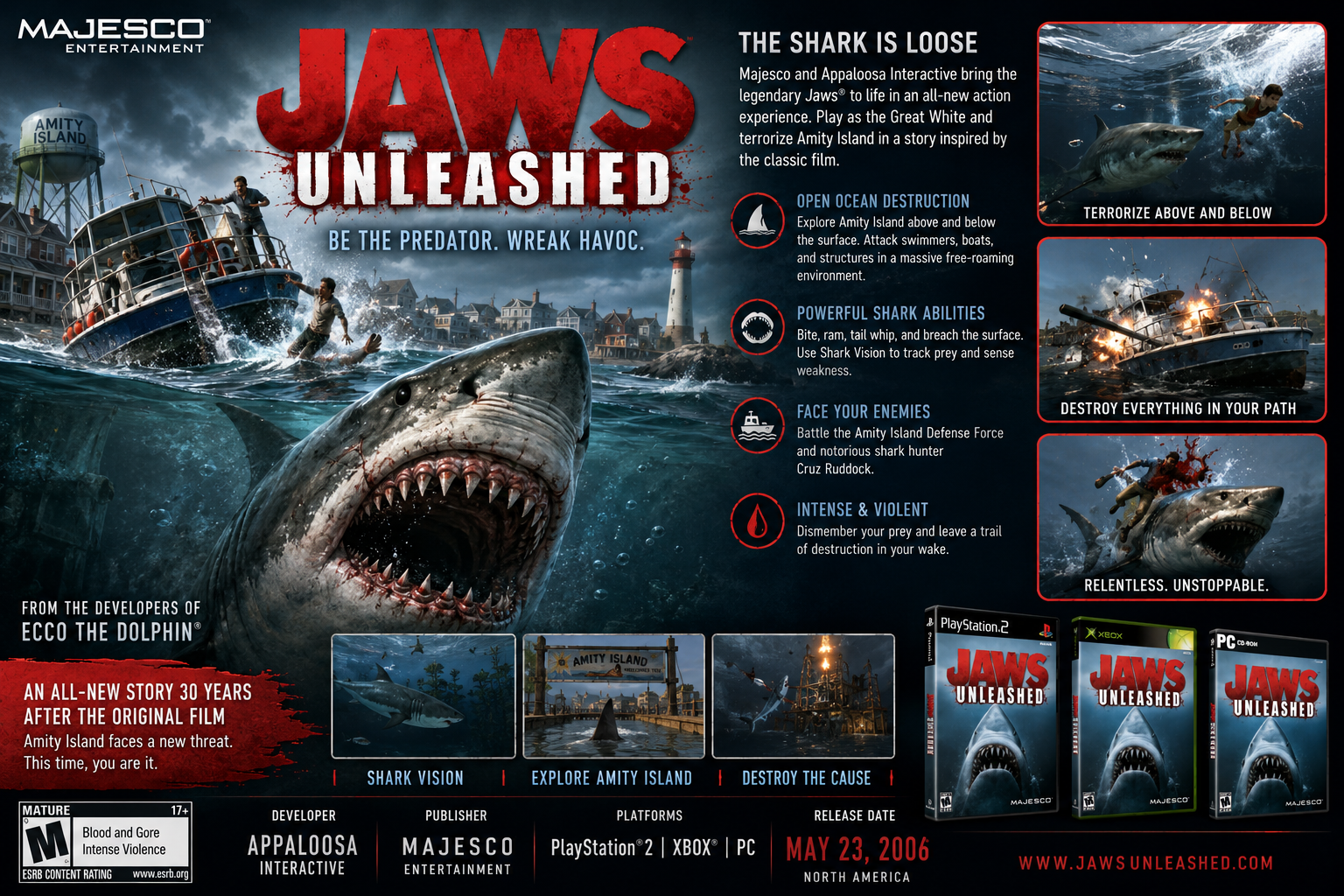
Modern archive illustration representing Majesco and Appaloosa Interactive's Jaws Unleashed, its Amity Island setting and its 2006 console release. This is a contemporary archival reconstruction, not original Majesco promotional artwork.
Jaws Unleashed at a Glance
| Title | Jaws Unleashed |
|---|---|
| Developer | Appaloosa Interactive |
| Publisher | Majesco |
| Licensed Property | Jaws |
| Platforms | PlayStation 2, Xbox and PC |
| North American Console Release | May 23, 2006 |
| North American PC Release | October 18, 2006 |
| Genre | Free-roaming action / action-adventure |
| Players | Single player |
| Setting | Amity Island approximately 30 years after the original Jaws film |
| Player Character | Great white shark |
| Earlier Project | Sole Predator |
| ESRB Rating | Mature – Blood and Gore, Intense Violence |
| Historical Majesco Role | License holder, publisher and promoter of the commercial Jaws game |
Before Jaws Unleashed, There Was Sole Predator
The history of Jaws Unleashed begins in July 2003, when Appaloosa Interactive announced a shark-action project called Sole Predator.
The concept already contained many of the ideas that would later define Jaws Unleashed.
According to the surviving 2003 Sole Predator announcement preserved by WorthPlaying, the player controlled a great white shark driven into a frenzy by low-frequency emissions from offshore oil-drilling operations.
The shark would attack the drilling crews and equipment responsible for disturbing its environment while also fighting other predators and hostile humans.
The project advertised:
- a playable great white shark;
- fully destructible environments;
- underwater, surface and airborne attacks;
- around 20 missions;
- other marine predators;
- human enemies;
- Shark Vision;
- violent dismemberment;
- environmental puzzles;
- and multiplayer concepts that were being considered during development.
This is important because those ideas existed before Majesco publicly introduced the Jaws license.
Jaws Unleashed was therefore not a game concept created from nothing after a movie-rights agreement. The underlying fantasy — controlling a destructive great white shark in a large underwater action game — was already part of Appaloosa's work.
The Final Game Still Carried Sole Predator's DNA
The similarities between Sole Predator and the finished Jaws Unleashed are substantial.
Both center on a playable great white shark. Both involve human activity disturbing the marine environment. Both emphasize destructible surroundings, underwater exploration, attacks against humans and machines, Shark Vision and the ability to move between deep water and the surface.
GameSpot's final review explicitly acknowledged this development lineage.
The GameSpot Jaws Unleashed review noted that the project had originally been announced in 2003 as Sole Predator, before the Jaws license became attached to it.
That makes the transition historically clearer:
Sole Predator provided the shark-game foundation; the Jaws license supplied a famous identity, setting and cinematic universe.
The license changed how the project could be marketed and contextualized, but many of its core mechanical ideas were already present.
Majesco Secured the Jaws License in 2004
On August 18, 2004, Majesco publicly announced that it was developing a game based on Universal's Jaws property.
The company initially planned to release the game in summer 2005, intentionally aligning the launch with the 30th anniversary of the original 1975 film.
The contemporary GameSpot announcement identified Appaloosa Interactive as developer and emphasized the most important reversal in the game's design: players would control the shark rather than the humans trying to stop it.
Majesco CEO Jesse Sutton positioned the concept as an opportunity to capture some of the recognition and excitement associated with the film while allowing the shark to deliver the retaliation.
This was a natural marketing proposition.
Jaws was already one of cinema's most recognizable predator identities. A video game could offer something the film fundamentally could not: direct control over that predator.
Why Appaloosa Was a Natural Developer for Jaws
Appaloosa Interactive was an unusually logical studio for an underwater action game.
The developer was already strongly associated with Ecco the Dolphin, a series built around movement, exploration and interaction within three-dimensional underwater environments.
In a March 2005 interview with GameSpot, Majesco product manager Liz Buckley directly connected Appaloosa's background with the decision to use the studio for Jaws Unleashed.
The GameSpot Jaws Unleashed Q&A records Majesco describing Appaloosa's experience with convincing underwater environments as a major reason the developer fit the project.
Majesco also said its product-development team already had a relationship with Appaloosa.
The resulting entity relationship was therefore more meaningful than a random license assignment:
Appaloosa underwater expertise → existing shark-game concept → Majesco relationship → recognizable Jaws license.
From Ecco the Dolphin to Its Violent Opposite
The contrast with Ecco the Dolphin became impossible to ignore once Jaws Unleashed was released.
Appaloosa had previously created underwater adventures in which a dolphin explored marine environments and often worked to save other creatures.
Jaws Unleashed turned that experience inside out.
Instead of a graceful dolphin, the player controlled a huge predator.
Instead of protecting life, the player could consume it.
Instead of navigating the ocean primarily through exploration, the environments became spaces for destruction.
GameSpot's review described the result as effectively the “anti-Ecco”: an underwater action game produced by a studio with proven marine-game experience but built around a completely opposite fantasy.
Jaws Unleashed Was Not a Direct Retelling of the Movie
Majesco and Appaloosa deliberately avoided turning the game into a scene-by-scene adaptation of Steven Spielberg's original film.
The game instead takes place approximately 30 years after the events of Jaws.
Amity Island has again become a prosperous community, but human development begins disturbing the surrounding marine environment. A great white shark arrives and soon becomes the central threat.
Characters and ideas from the film universe appear in modified form. Michael Brody, son of police chief Martin Brody, is now a marine biologist involved in the effort to understand or capture the shark.
In its 2005 GameSpot interview, Majesco explicitly explained why a direct translation of the film would have been awkward.
The movie is fundamentally told from the human perspective.
The game was designed around the opposite point of view.
That required a continuation rather than a straightforward recreation.
Instead of Hunting Jaws, You Were Jaws
The game's strongest idea can be explained in one sentence:
the shark is the player character.
Jaws can bite prey, ram boats and structures, strike with its tail, drag victims through the water and breach through the surface.
Humans, marine animals and vehicles can all become targets.
The shark can also use a specialized sensory mode generally referred to as Shark Vision to identify important objects and potential prey.
Majesco's 2005 GameSpot Q&A emphasized that biting, tearing, dragging, swimming and breach attacks were considered essential to making the player feel like a powerful marine predator.
The studio then attempted to build conventional action-game structures around those abilities.
Appaloosa Tried to Build an Open Shark Sandbox
Jaws Unleashed was not designed as a sequence of narrow movie scenes.
Majesco described it as a free-roaming action game.
After the early missions, the player could move around large portions of Amity Island and attack people, boats, dolphins, seals and other wildlife while discovering challenges and destructible objects.
The world contained more structured missions as well.
Pre-release material described:
- stealth missions;
- chase sequences;
- timed destruction challenges;
- boss encounters;
- aquariums;
- deep-sea areas;
- oil-drilling facilities;
- docks;
- piers;
- and beaches.
By June 2005, GameSpot described ten destructible environments alongside free-roaming play and side missions.
See the June 2005 GameSpot preview.
The underlying concept was unusually easy to understand:
an underwater action sandbox built around the destructive abilities of a great white shark.
Japanese Press Was Following the Game Before Release
Jaws Unleashed developed an international media footprint well before it reached stores.
On April 5, 2005, Japanese gaming publication 4Gamer published new screenshots and described the unusual reversed perspective of the game.
The 4Gamer Jaws Unleashed report identified:
- Appaloosa Interactive as developer;
- Majesco Entertainment as publisher;
- Amity Island as the setting;
- the great white shark as the player character;
- and PC, Xbox and PlayStation 2 as the planned platforms.
4Gamer also directed readers toward Majesco's official product presence for the game.
That makes the article particularly useful for this archive: it independently confirms that Majesco maintained a dedicated web presence for Jaws Unleashed during the game's pre-release period without relying solely on Majesco's own promotional material.
Jaws Unleashed Drew Attention at E3 2005
The international attention continued at E3.
4Gamer's May 2005 hands-on coverage described a demo in which the shark attacked windsurfers and fishing boats while also fighting hammerhead sharks and patrol vessels.
The Japanese publication already recognized both the appeal and potential design problem of the concept: being a shark was unusual and entertaining, but the action risked becoming repetitive if the finished missions did not create enough variety.
The 4Gamer E3 2005 hands-on report therefore provides an interesting pre-release counterpart to criticisms that would later appear in final reviews.
The basic fantasy was strong.
The challenge was finding enough different things for a shark to do.
The Original 30th-Anniversary Launch Never Happened
The release schedule changed repeatedly.
Majesco's August 2004 announcement originally targeted summer 2005, intentionally connecting the game to the 30th anniversary of the movie.
By June 2005, GameSpot was reporting an August 2005 launch.
That date also passed.
In September 2005, 4Gamer reported that Majesco had postponed the release from an expected late-2005 window into the first half of 2006.
Importantly, 4Gamer explicitly said that the reason for the delay was unknown.
See the September 2005 4Gamer delay report.
By November, GameSpot described a working build with a February 2006 target.
The November 2005 GameSpot impressions also noted that the game had become noticeably bloodier since its earlier E3 appearance.
February came and went as well.
The console versions finally reached North American retail on May 23, 2006.
A Nearly Two-Year Development Plan Became an Even Longer Project Lineage
In March 2005, Majesco estimated that Jaws Unleashed would have been in development for approximately two years by its expected launch.
That statement aligns closely with Sole Predator's public appearance in July 2003.
Once the repeated delays are included, the complete development lineage becomes even longer:
2003: Sole Predator announced
2004: Majesco announces the Jaws license
2005: Jaws Unleashed promoted heavily but delayed
2006: console versions finally released
The chronology helps explain why the project should not be treated as a rushed movie tie-in created only to exploit an anniversary.
The game missed the anniversary window entirely, but the shark-action concept itself had been developing for years.
The Game Became Far More Violent Than the Movie's Rating Suggested
Majesco and Appaloosa leaned heavily into the role reversal.
The player was not merely swimming around Amity Island as a recognizable shark model. The game allowed Jaws to attack people directly, tear apart prey, destroy boats and leave visibly violent results behind.
The finished release received an ESRB Mature rating for Blood and Gore and Intense Violence.
The GameFAQs release record preserves the final rating, Appaloosa development credit, Majesco publishing credit and May 23 console release date.
The violent presentation was not an accidental side effect.
It was part of the core fantasy of finally letting the shark become the protagonist.
The Great Premise Collided With Difficult Controls
The finished game had an immediately compelling idea and serious execution problems.
GameSpot gave Jaws Unleashed 3.8 out of 10.
The harshest criticism focused on the controls and camera.
Controlling a large animal moving freely through three-dimensional water creates a fundamentally different navigation problem from controlling a human character walking across the ground.
Targets could exist:
- above the shark;
- below the shark;
- behind it;
- at the surface;
- or inside structures.
GameSpot found that the camera frequently made those relationships difficult to interpret, particularly during combat or missions requiring precision.
The controls became especially frustrating when the game demanded more than simply attacking nearby prey.
That created a mismatch between fantasy and execution.
Being a giant shark sounded immediately entertaining; precisely controlling that shark through conventional action-game objectives was much harder.
The Missions Sometimes Fought Against the Shark Fantasy
Another major criticism was mission design.
The most natural fantasy in Jaws Unleashed is simple: swim freely, hunt prey and destroy obstacles.
Many missions instead required puzzle-like interactions or precise sequences that did not always feel natural for an uncontrolled marine predator.
GameSpot highlighted scenarios in which the shark was effectively required to manipulate human-oriented objects or use environmental elements in highly specific ways to advance.
The absurdity could sometimes become entertaining in its own right, but critics generally viewed these objectives as evidence that the game was forcing conventional action-game structures onto a protagonist poorly suited to them.
This is one reason the free-roaming portions often sounded more appealing than the campaign missions themselves.
The Technology Also Showed Signs of Strain
The final review identified additional technical weaknesses.
GameSpot praised the shark model itself as reasonably detailed and naturally animated, but found much of the surrounding presentation less convincing.
Problems included:
- limited draw distance;
- weak human character models;
- inconsistent frame rate;
- animation glitches;
- bugs;
- and occasional crashes encountered during review.
The Xbox version offered somewhat cleaner visuals than the PlayStation 2 version, but GameSpot reported severe performance drops in certain busy underwater scenes.
The game therefore struggled not because Appaloosa lacked underwater-game experience, but because the scale and structure of this particular shark sandbox introduced a very different set of technical and design challenges.
Critics Were Harsh, but Players Were More Divided
GameSpot's 3.8 was not an isolated negative reaction.
The historical aggregate sits around the low-50s, with the PlayStation 2 and Xbox versions receiving generally mixed-to-negative critical assessments.
The GameFAQs review archive preserves a Metacritic score of approximately 51 for the console release and a broad range of contemporary opinions.
Player responses were more forgiving.
Some user reviews criticized exactly the same control and camera problems identified by professional critics. Others awarded the game scores in the seven- or eight-out-of-ten range because they found the basic concept of roaming Amity Island as a shark entertaining enough to outweigh the mechanical shortcomings.
One contemporary user even summarized the fantasy as a kind of underwater Grand Theft Auto.
That description is not a technical classification, but it captures why some players responded differently from critics:
the freedom to cause destruction as a shark was unusual enough to generate entertainment even when the formal game design was weak.
Poor Reviews Did Not Stop Jaws Unleashed From Selling
The most surprising part of the game's history came after release.
Despite weak critical reviews, Jaws Unleashed developed a meaningful commercial footprint.
In January 2007, Majesco reported worldwide sales of nearly 600,000 units for the Xbox and PlayStation 2 versions.
The GameSpot report on Majesco's fiscal results specifically identified solid Jaws Unleashed sales as one factor contributing to improved revenue.
This creates one of the more interesting contradictions in Majesco's catalog:
GameSpot review: 3.8/10
historical critical aggregate: roughly low-50s
Majesco-reported Xbox and PS2 sales: nearly 600,000 units worldwide.
A poorly reviewed game had nevertheless found a substantial audience.
The Jaws License and the Shark Fantasy May Have Mattered More Than the Reviews
There is no single surviving source that can precisely explain why Jaws Unleashed sold as well as Majesco later reported.
However, the product possessed two unusually strong consumer hooks.
The first was the Jaws name, backed by decades of recognition from the film.
The second was the immediately understandable fantasy of playing as the shark.
Neither required a consumer to understand complicated mechanics or follow specialist game coverage.
A box showing a great white shark and promising that the player could terrorize Amity Island communicated the concept almost instantly.
The sales therefore should not be used to erase the game's technical shortcomings, just as the low review scores should not erase its commercial footprint.
Both are part of the historical record.
Jaws Unleashed Survived a Turbulent Period for Majesco
The long development cycle also overlapped with one of the most difficult periods in Majesco's history.
During 2004 and 2005, the publisher was attempting to move beyond its older reputation for inexpensive software and support a more ambitious slate of console projects.
That broader era is represented elsewhere in this archive by titles such as Psychonauts, BloodRayne 2 and Infected.
By 2006, Majesco was changing direction again.
The company began reducing its exposure to expensive console development and rebuilding its strategy around more affordable, mass-market products.
Jaws Unleashed sits awkwardly but interestingly between those phases.
It originated during Majesco's more ambitious licensed-console period, survived repeated delays and eventually became a meaningful seller while the company was changing its business model.
When Majesco reported the game's nearly 600,000 console sales in early 2007, the same financial announcement emphasized the company's transition toward lower-cost, mass-market software.
Jaws therefore became a commercial bridge between two very different versions of Majesco.
From a Shark Prototype to a Licensed Jaws Release
Seen as a complete development story, Jaws Unleashed is much more interesting than a conventional movie-license game.
The lineage begins with Appaloosa rather than Universal.
Sole Predator established the basic shark fantasy.
Majesco brought the Jaws license and commercial publishing operation.
Appaloosa's Ecco background supplied years of experience with underwater environments.
Jaws transformed the anonymous shark concept into one of cinema's most recognizable predators.
The result was neither a direct adaptation of Spielberg's film nor an entirely new game concept created after acquiring the license.
It was a convergence of an existing development project and an established entertainment property.
Historical Sources and Surviving References
This reconstruction prioritizes contemporary development announcements, Majesco-era interviews, international pre-release coverage, final release records and Majesco's later commercial reporting.
- WorthPlaying — Sole Predator Announced, July 2003. Preserves Appaloosa's original license-free shark-action concept before Majesco announced the Jaws game.
- ```
- GameSpot — Majesco Gobbles Up Jaws License, August 2004. Contemporary announcement documenting Majesco's Jaws project, Appaloosa's development role and the original summer 2005 / 30th-anniversary release plan.
- GameSpot — Jaws Unleashed Q&A, March 2005. Majesco product manager Liz Buckley explains the 30-years-later setting, Appaloosa relationship, Ecco experience, shark perspective, free-roaming design and planned mission structure.
- 4Gamer — Jaws Unleashed Screenshots and Pre-Release Report, April 2005. Contemporary Japanese coverage connecting Appaloosa, Majesco, Amity Island and Majesco's dedicated official product presence.
- 4Gamer — E3 2005 Jaws Unleashed Hands-On. Preserves international pre-release impressions of the shark combat, marine enemies and mission design.
- GameSpot — Jaws Unleashed Tangled in the Net, June 2005. Documents the free-roaming structure, destructible environments, Amity Island setting and the then-current August release target.
- 4Gamer — Majesco Delays Jaws Unleashed, September 2005. Contemporary report confirming the move into the first half of 2006 and stating that the reason for the delay had not been disclosed.
- GameSpot — Jaws Unleashed Impressions, November 2005. Documents the later build, approximately 30-years-after-the-film story and increased level of violence.
- GameFAQs — Jaws Unleashed Release Data. Confirms Appaloosa Interactive as developer, Majesco as publisher, the Mature rating and the May 23, 2006 North American console release.
- GameSpot — Jaws Unleashed Review, May 2006. Documents the Sole Predator lineage, free-roaming structure, control and camera problems, technical weaknesses and 3.8/10 review.
- GameSpot — Majesco Q4 Revenues Spike, January 2007. Records Majesco's report of nearly 600,000 Jaws Unleashed units sold worldwide across Xbox and PlayStation 2.
- ```
Preserving Jaws Unleashed in the Majesco Games Archive
Jaws Unleashed deserves a dedicated historical record because its Majesco relationship can be reconstructed unusually well.
The game began with an independent Appaloosa concept called Sole Predator. Majesco later secured access to the Jaws property and combined that recognizable license with a developer already experienced in underwater games and already building a playable-shark project.
The commercial version then went through a long development cycle, missed its intended 30th-anniversary release, suffered repeated delays and eventually arrived to harsh reviews in May 2006.
Yet the story did not end with the review scores.
Majesco later reported nearly 600,000 worldwide Xbox and PlayStation 2 sales, demonstrating that the combination of the Jaws brand and the unusual player fantasy reached a significant audience despite serious design problems.
The historical entity chain can therefore be summarized as:
Appaloosa Interactive → Sole Predator → Majesco + Universal's Jaws license → Jaws Unleashed → delayed 2006 release → weak reviews → substantial console sales.
That development and publishing relationship is the specific historical record preserved here within the Majesco Games Archive.
Related records include the Majesco Games Historical Catalog, Majesco Press Archive, Psychonauts, Infected, BloodRayne 2 and HSX: HyperSonic.Xtreme.
MajescoGames.com Today
MajescoGames.com is now independently operated. Selected records associated with the domain's earlier Majesco era are preserved for historical reference, while the current website focuses on browser gaming with Escape Road as its primary game experience.
Visit MajescoGames.com to explore the current site.


