Majesco Game Boy Advance Accessories: Wireless Link, Messenger & More
By 2004, Majesco was using the Game Boy Advance for more than conventional game publishing. Alongside its growing software catalog, the company was experimenting with video playback, licensed audio hardware and wireless products designed to expand what Nintendo's handheld could do.
Those efforts included Game Boy Advance SP Neckband Headphones, a Wireless Link intended to replace conventional multiplayer link cables, and the more ambitious Wireless Messenger, which attempted to turn a Game Boy Advance into a portable text-communication device.
Contemporary Majesco announcements and independent gaming publications show that these products were represented together through a dedicated accessories section on the historical MajescoGames.com website. That category-level relationship is preserved here as part of the Majesco Games Archive.
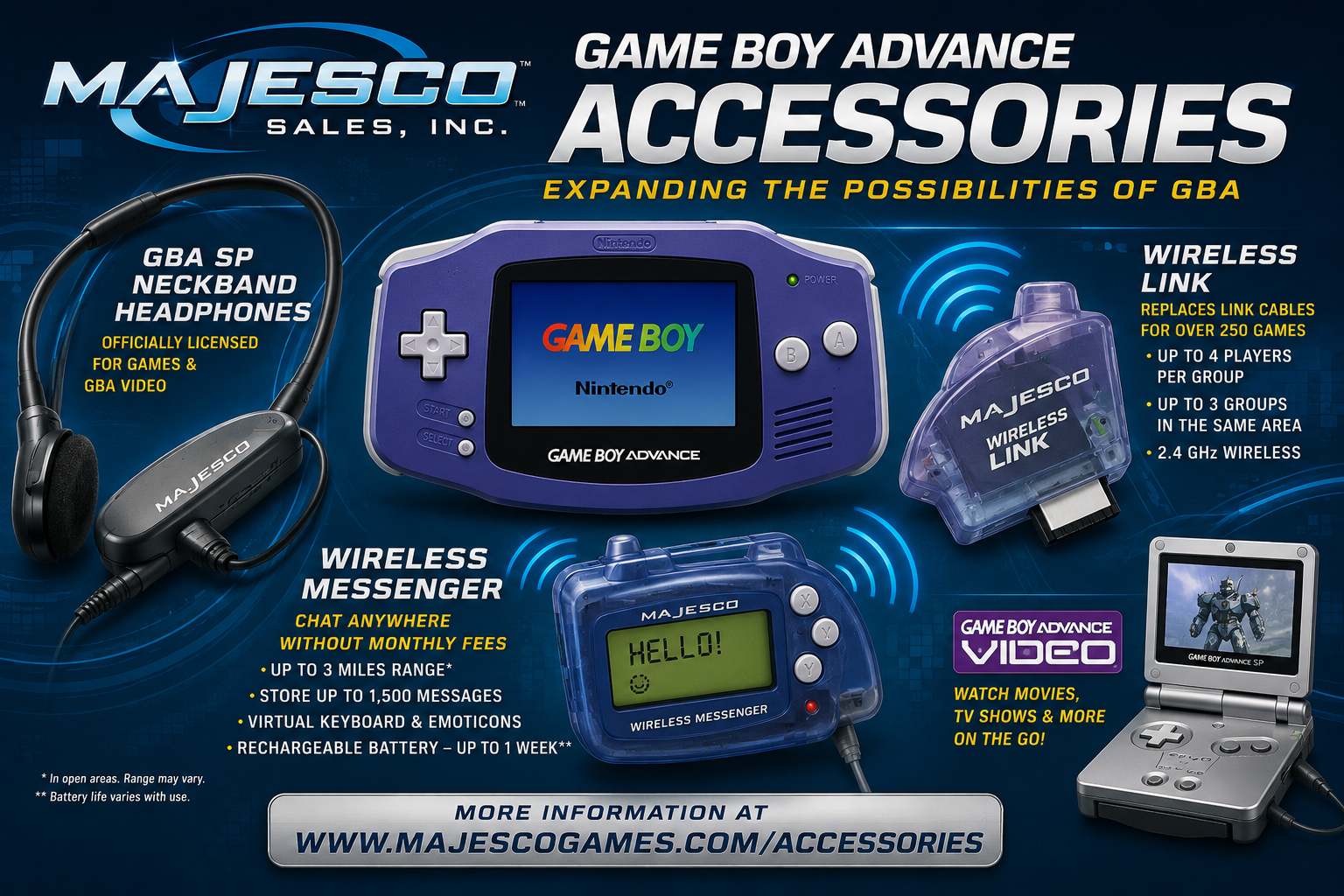
Modern archive illustration representing Majesco's 2004 Game Boy Advance accessory ecosystem, including GBA SP headphones, Wireless Link and Wireless Messenger. This is a contemporary archival reconstruction, not original Majesco advertising artwork.
Majesco's Game Boy Advance Accessories at a Glance
| Historical Category | Game Boy Advance and Game Boy Advance SP accessories |
|---|---|
| Company | Majesco Sales, Inc. |
| Key Period | 2004 |
| GBA SP Neckband Headphones | Licensed audio accessory promoted for games and GBA Video |
| Wireless Link | Wireless alternative to the conventional GBA multiplayer link connection |
| Wireless Messenger | Wireless text messaging and chat accessory |
| Related Majesco Technology | Game Boy Advance Video |
| Historical Website Role | Dedicated MajescoGames.com accessories category covering multiple GBA products |
Majesco Was Trying to Push the GBA Beyond Games
The accessory business makes more sense when viewed alongside Majesco's wider Game Boy Advance strategy.
The company had already invested heavily in the platform as a software publisher. Historical releases preserved in this archive include Earthworm Jim GBA, Earthworm Jim 2 GBA and Fortress.
By 2004, however, Majesco was pursuing a broader idea: use the large installed base of Game Boy Advance and Game Boy Advance SP systems for entertainment and communication functions beyond conventional cartridges.
One major component was Game Boy Advance Video, which used Majesco's proprietary compression technology to place television and video content on GBA cartridges.
In April 2004, Majesco announced technology capable of compressing approximately 45 minutes of video into a 32 MB cartridge while preserving functions such as fast-forward, rewind and chapter navigation.
The Majesco video-technology announcement preserved by Nintendo World Report demonstrates that the company was actively exploring the Game Boy Advance as a broader portable entertainment platform.
Audio and wireless accessories were part of the same expansion.
GBA SP Neckband Headphones Connected Accessories to GBA Video
In April 2004, Majesco announced licensed Game Boy Advance SP Neckband Style Headphones for North America.
The accessory was designed specifically for the GBA SP and could be connected without an additional headphone adapter. Majesco promoted it for use with both ordinary games and Game Boy Advance Video cartridges.
The timing was significant. Majesco was beginning to build a wider ecosystem around its portable video strategy, and dedicated headphones made considerably more sense once the GBA SP was also being marketed as a device capable of playing television content.
Majesco CEO Jesse Sutton said at the time that the company was Nintendo's licensed accessory manufacturer for Game Boy Advance in North America.
The April 2004 Majesco headphone announcement also confirms that the company maintained a dedicated accessories destination on its historical website.
This is important because it establishes the accessories category before Majesco's wireless products became the main focus of later discussion.
Majesco Announces a Wireless Push in May 2004
Only one month later, Majesco revealed a substantially more ambitious expansion of its Game Boy Advance accessory strategy.
On May 6, 2004, GameSpot reported that the company planned to introduce both Wireless Link and Wireless Messenger products for Game Boy Advance.
The accessories were being prepared for public demonstration around E3 2004. At the time, GameSpot reported that they were still awaiting Nintendo licensing approval.
Majesco's business argument was straightforward. Jesse Sutton pointed to the large North American Game Boy Advance installed base and argued that technologies such as video compression and wireless communication could extend the usefulness of hardware consumers already owned.
The GameSpot report on Majesco's wireless plans places the accessories inside this broader strategy rather than presenting them as isolated novelty products.
Wireless Link: Replacing the Physical GBA Link Cable
The simpler of Majesco's two wireless concepts was the Wireless Link.
Its goal was to provide wireless multiplayer communication without requiring players to connect their Game Boy Advance systems using a physical link cable.
This approach distinguished the Majesco accessory from Nintendo's own Game Boy Advance Wireless Adapter.
Nintendo's adapter depended on individual games being specifically designed to support the accessory. Majesco instead marketed Wireless Link as a wireless substitute for the standard GBA multiplayer connection, potentially giving it compatibility with a much larger existing library.
The Nintendo World Report Wireless Link profile preserves Majesco's advertised specifications:
- compatibility claimed for more than 250 GBA multiplayer games;
- support for Game Boy Advance and Game Boy Advance SP;
- up to four players in an individual group;
- up to three separate four-player groups within the same area;
- automatic discovery of nearby Wireless Link units;
- link-status indication;
- power drawn from the GBA serial expansion port;
- and operation in the 2.4 GHz ISM radio band.
The key selling point was therefore not simply wireless communication. It was the possibility of giving existing link-cable multiplayer games wireless functionality without requiring those games to be rewritten for a new protocol.
Wireless Link and Nintendo's Wireless Adapter Were Different Products
The similarity in product names led to understandable confusion among players.
Nintendo had announced its own Game Boy Advance Wireless Adapter in 2003. That accessory later became closely associated with games such as Pokémon FireRed and Pokémon LeafGreen.
However, compatible software needed explicit support for Nintendo's adapter. The original Nintendo wireless announcement made this game-specific requirement clear.
Majesco's product was marketed around a different idea: reproduce the conventional multiplayer connection without the physical cable.
This distinction was already being discussed by players in 2004. An August 2004 discussion on ElOtroLado compared Majesco's approach with Nintendo's wireless hardware and directed readers toward Majesco's accessories information.
The discussion is useful because it preserves how consumers understood the difference while both technologies were still current.
Wireless Messenger Tried to Turn the GBA Into a Communicator
The Wireless Messenger was considerably more unusual.
Instead of extending multiplayer games, it was designed to transform the Game Boy Advance or Game Boy Advance SP into a dedicated text-communication device.
Majesco described individual messages, group communication and real-time chat without requiring users to subscribe to a cellular service or pay a monthly communication fee.
Text was entered using an on-screen virtual keyboard controlled through the GBA buttons.
The Nintendo World Report Wireless Messenger profile preserves a detailed set of Majesco's advertised features:
- support for Game Boy Advance and Game Boy Advance SP;
- individual and group messaging;
- real-time and private chat;
- an advertised open-area range of up to three miles;
- communication across several city blocks in more obstructed environments;
- no monthly wireless service fee;
- an on-screen virtual keyboard;
- emoticons and user icons;
- an internal rechargeable battery;
- advertised operation of up to one week per charge;
- storage for as many as 1,500 messages;
- automatic retry for failed deliveries;
- optional delivery confirmation;
- discovery of nearby named units;
- multiple communication channels;
- and frequency-hopping spread-spectrum communication.
For an accessory attached to hardware originally designed primarily for games, that was an unusually ambitious feature set.
The Three-Mile Range Claim Drew Attention
One specification received more attention than almost any other: Majesco's advertised three-mile open-area range.
Three miles is approximately 4.8 kilometers, substantially farther than consumers might normally have associated with local handheld multiplayer communication at the time.
A September 2004 article on Dutch site FOK! described the product as supporting approximately five kilometers under favorable conditions, while also noting the advertised battery life and large message-storage capacity.
The accompanying discussion directed readers back to Majesco's accessory information.
The surviving FOK! coverage of Wireless Messenger is therefore useful for two reasons: it preserves the contemporary product specifications and independently confirms the association between Wireless Messenger and Majesco's wider accessories category.
Players also questioned how closely real-world urban performance would match a maximum open-area specification. That skepticism helps show how central the range claim was to the product's identity.
Majesco's Wireless Products Appeared at the Start of the Nintendo DS Era
The timing made Wireless Messenger particularly interesting.
Majesco announced its wireless Game Boy Advance products in early May 2004, during the same period in which Nintendo was publicly preparing to unveil the Nintendo DS.
The DS introduced integrated wireless communication and PictoChat, which allowed nearby users to exchange text and drawings without purchasing a separate messaging accessory.
The two approaches were not identical.
Majesco was attempting to add messaging to the enormous installed base of existing Game Boy Advance hardware. Nintendo was building wireless communication directly into a new handheld platform with a touch screen and stylus.
Nevertheless, contemporary players naturally compared them.
A December 2004 NeoGAF discussion explicitly questioned whether Majesco's Messenger remained attractive once the Nintendo DS and PictoChat had entered the market.
The discussion also provides independent evidence that consumers associated both Wireless Messenger and Wireless Link with Majesco's broader accessories offering.
What Was Actually Available by Late 2004?
The precise retail chronology of Majesco's wireless products is not perfectly preserved.
Some later databases assign an October 2004 date to both Wireless Link and Wireless Messenger.
However, contemporary reporting complicates that picture.
A September 2004 Nintendo World Report article still described Majesco's wireless products as upcoming. In December, a NeoGAF user reported seeing the Wireless Link at retail but said they had not yet encountered the Wireless Messenger.
The same contemporary discussion referenced a price of approximately $9.99 for Wireless Link.
This kind of forum evidence should not be treated as proof of a national release date. It does, however, provide useful evidence that Wireless Link had reached at least some retail channels by the end of 2004 while Wireless Messenger availability was less obvious.
For that reason, the safest historical description is that Majesco's major wireless push occurred during late 2004, rather than assigning every accessory one rigid launch date based on later database entries.
The Historical Majesco Accessories Section Had Category-Level Intent
One of the strongest pieces of evidence comes from the way different contemporary sources referred readers back to Majesco.
Majesco's own GBA SP headphone announcement sent readers to its dedicated accessories information.
Later, independent discussions of Wireless Link and Wireless Messenger directed readers to the same historical section of MajescoGames.com.
That gives the historical destination a clear multi-product relationship:
GBA SP Neckband Headphones → Majesco accessories category
Wireless Link → Majesco accessories category
Wireless Messenger → Majesco accessories category
This is important because it shows that Majesco's historical accessories destination should not be reconstructed as a page about Wireless Messenger alone.
It represented a broader Game Boy Advance accessory ecosystem.
Why This Page Preserves the Broader Accessory Category
The historical evidence supports category-level intent rather than a single-product destination.
A visitor could have reached Majesco's accessory information while researching headphones, wireless multiplayer or portable messaging.
The current Game Boy Advance Accessories archive record therefore preserves all three major product relationships instead of narrowing the historical subject to one accessory.
This also distinguishes the page from the broader Hardware and Accessories archive.
The broader historical page covers Majesco's involvement with hardware and accessories across multiple product categories. This page focuses specifically on the Game Boy Advance accessory ecosystem that developed around the handheld in 2004.
Accessories Were Part of a Wider Majesco Hardware Strategy
The GBA products were only one expression of Majesco's interest in business models beyond conventional boxed games.
During the same general period, the company was working with video-on-cartridge technology, wireless communication and other low-cost consumer gaming hardware.
The broader historical context is preserved through the Hardware and Accessories record and TV Arcade.
For Game Boy Advance specifically, Majesco's strategy can be summarized as:
games → portable video → audio accessories → wireless multiplayer → wireless messaging.
This progression is what makes the accessory category historically interesting. Majesco was not merely selling replacement cables or decorative peripherals. It was experimenting with ways to extend the functionality of a platform that already had millions of users.
Historical Sources and Surviving References
This reconstruction uses Majesco-era announcements, contemporary reporting and surviving community discussions that preserve the relationship between these products and Majesco's historical accessory category.
- Nintendo World Report — Majesco Announces GBA SP Neckband Headphones, April 2004. Preserves Majesco's announcement of the licensed GBA SP audio accessory and confirms the company's dedicated accessories section.
- ```
- Nintendo World Report — Majesco Patents Video Technology, April 2004. Documents Majesco's effort to extend Game Boy Advance into portable video playback.
- GameSpot — GBA Going Wireless with Majesco, May 6, 2004. Contemporary announcement of Majesco's Wireless Link and Wireless Messenger strategy.
- Nintendo World Report — Wireless Link. Preserves Majesco's compatibility, multiplayer and radio specifications.
- Nintendo World Report — Wireless Messenger. Preserves Majesco's claimed range, message capacity, battery and communication features.
- Nintendo World Report — New Majesco GBA Wireless Products, September 2004. Contemporary coverage of the two wireless accessories before widespread retail availability.
- FOK! — Wireless Chatten op je GBA, September 2004. European coverage of Wireless Messenger and contemporary discussion of Majesco's accessory information.
- ElOtroLado — GBA Wireless Discussion, August 2004. Contemporary discussion comparing Majesco's wireless solution with Nintendo's hardware.
- NeoGAF — Anyone Tried the Wireless Messenger for GBA?, December 2004. Contemporary consumer discussion of Wireless Messenger, Wireless Link and observed retail availability.
- ```
Preserving Majesco's Game Boy Advance Accessory History
Majesco's Game Boy Advance accessory strategy represents a distinctive period in the company's history.
The company had already established itself as a publisher of GBA software, but by 2004 it was also experimenting with portable video, licensed audio hardware and wireless communication.
Contemporary evidence connects several different products to the same historical Majesco accessory category, demonstrating that the original website treated them as part of a broader ecosystem rather than unrelated devices.
The historical entity relationship can therefore be reconstructed as:
Game Boy Advance → Majesco portable strategy → GBA SP headphones + Wireless Link + Wireless Messenger → Majesco accessories category.
This page preserves that category-level relationship as part of the Majesco Games Archive.
For broader hardware context, see Hardware and Accessories. For Majesco's historical software catalog and corporate announcements, visit Majesco Games Historical Catalog and the Majesco Press Archive.
MajescoGames.com Today
MajescoGames.com is now independently operated. Selected records associated with the domain's earlier Majesco era are preserved for historical reference, while the current website focuses on browser gaming with Escape Road as its primary game experience.
Visit MajescoGames.com to explore the current site.


